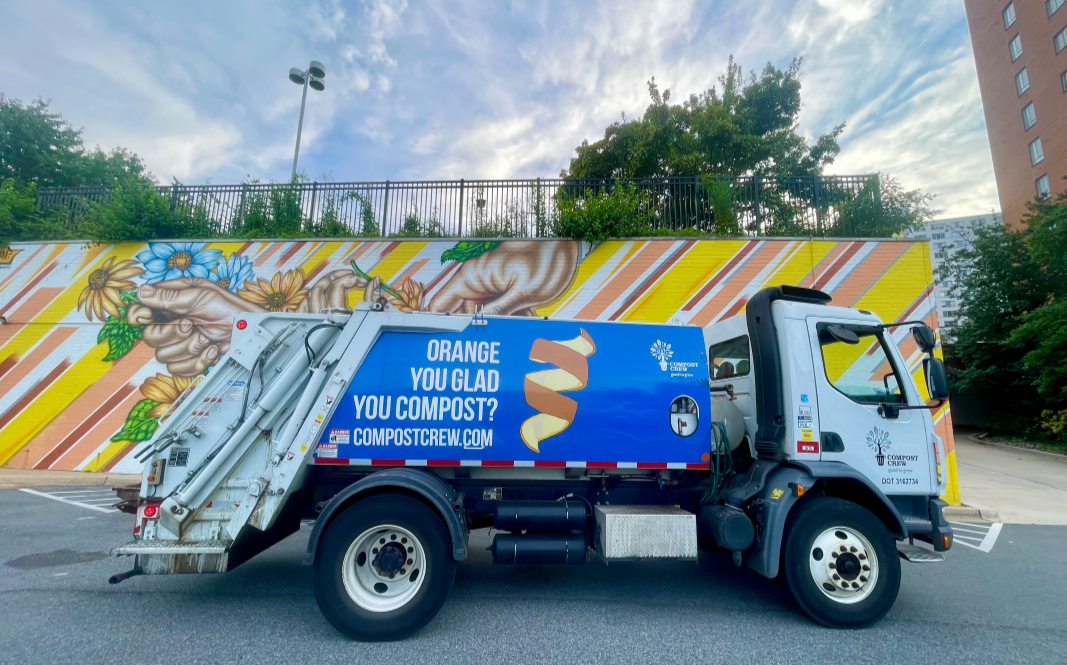
Top: Food scraps collection vehicle used by Compost Crew. Photo courtesy Compost Crew.
Julia Spector and Nora Goldstein
Local governments are uniquely positioned to foster local composting — they have the power to pass ordinances, enter into procurement contracts, provide services, offer land access, raise revenue, and more. Equally important, local composters are uniquely positioned to enable local governments to begin offering food scraps collection access to their residents, creating the infrastructure necessary to service a program.
This symbiotic relationship is at the heart of Keep Compost Local: A Roadmap for Local Governments to Build Prosperity with Composting — released in January 2026 by the Institute for Local Self-Reliance (ILSR). The Roadmap aims to equip and empower local governments to support and partner with local community composters and other community-based organizations to work toward shared goals. A key focus of this content is on successful public-private partnerships (PPPs).
The Roadmap is built upon research, in-depth case studies, a “Census” survey of community composters, and ILSR’s years of experience working directly with community composters and local governments. It was funded under grants to ILSR from the 11th Hour Project, the United States Environmental Protection Agency, and other donors.
Filling A Service Gap
At its core, local composting is characterized by the collection, processing, and use of materials within the same communities where food scraps are generated. In addition to sourcing organic materials locally and using finished compost in local soils, community composting typically engages the community in the composting process. This local approach amplifies the cross-sectoral benefits of composting.
In communities around the country, local composters have stepped in to keep food scraps out of landfills by bootstrapping their way to offering collection and composting services to residents and businesses. They invest in vehicles, buckets, carts, composting equipment, labor, drop-off stations, and outreach and education, and earn revenue from subscriptions, collection contracts and compost sales. In short, these individuals experienced a gap in the marketplace (frequently not finding any local options to divert food scraps), and stepped in to fill the void.
As local governments determine they want to initiate a food scraps collection and composting program, e.g., a pilot project, they increasingly tap into this existing local collection and composting infrastructure as a way to test the waters. “We needed to determine operationally what would work best from the District’s perspective for a pilot — including what the District would need to invest to provide the same service that a contractor would do,” explained Rachel Manning, Program Analyst at the Washington, D.C. Department of Public Works (DC DPW) Office of Waste Diversion in a case study. “While DC DPW had the ability to do the pilot in-house, the cost was so large, and we ran the risk of buying trucks and other collection equipment for a program that may or may not succeed.”

Credit: Sky Sabin
Caption: Volunteers from the University of Rhode Island Cooperative Extension’s Food Recovery for Rhode Island course helping process compost with Harvest Cycle
Providence, Rhode Island, would not be able to afford initiating and managing its own food scraps collection program; partnering with Groundwork RI and The Community Compost Depot allows it to engage in composting services. The City of Cleveland does not have its own infrastructure for diverting food scraps; however, existing partnerships with businesses like Rust Belt Riders and nonprofit organizations like Rid-All enable the City to reduce the amount of solid waste sent to landfills.
Tapping the experience of local composters also enables local governments to apply for federal and state grant funds to initiate a food scraps collection and/or composting pilot. For example, the U.S. Department of Agriculture’s Office of Urban Agriculture and Innovative Production created the Composting and Food Waste Reduction (CFWR) Cooperative Agreements to assist local and municipal governments with “projects that test strategies for planning and implementing municipal compost plans and food waste reduction plans.”
Key to receiving these grants was having a local partner to help implement the project. Many of the case studies in the Keep Compost Local report are recipients of the CFWR grants. Those local governments turned to local composters to create public-private partnerships (PPP) to deliver the services outlined in their applications. They were able to utilize the infrastructure, public engagement strategies, route logistics knowledge, composting know-how, contaminant management strategies and compost markets to hit the ground running at a significantly lower cost — and a higher likelihood of success — than if they had to initiate food scraps collection programs themselves.
Mutually Beneficial Relationships
What is evident throughout the Keep Compost Local report is that local governments and local composters build upon each other’s assets. This creates mutually beneficial collaborative relationships, and establishes a foundation for program expansion. For example, local governments can help modify zoning to accommodate a composting operation, pass through grant funds for equipment, and make land accessible for composting. Local composters can use the relationships they’ve nurtured in the community to give government programs credibility. By working directly in the community, often through multidimensional efforts, community composters and nonprofits have built relationships and trust with community members. Municipal programming can increase its chances of success by working with local partners that have built community collaboration into their mission.
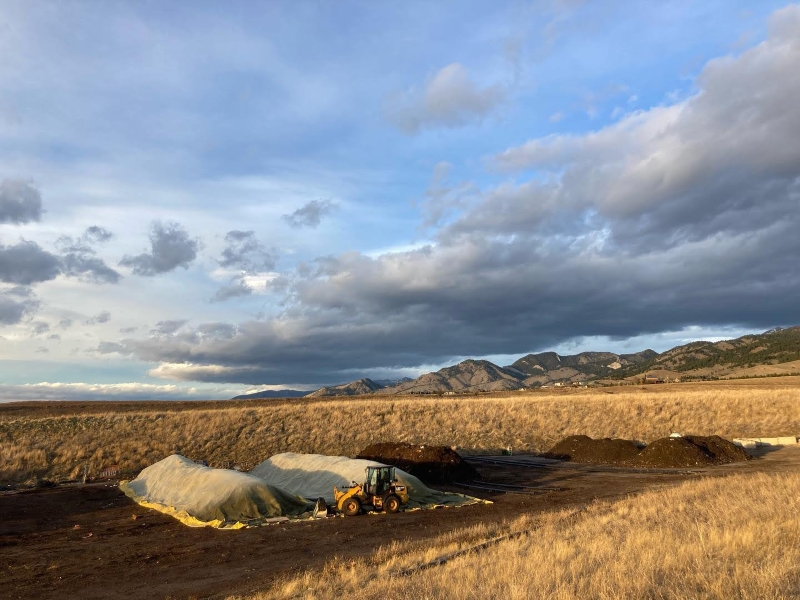
Credit: Happy Trash Can; Caption: SG Mobile® GORE® Cover aerated composting systems at Story Mill Convenience Site
Community composters’ pioneering efforts to collect and compost food scraps create the foundation for municipal governments to build upon. In each of the 15 case studies covering PPPs, the existing community composter was the key to making residential and commercial food scrap collection and composting — whether as a pilot or a program expansion — a reality.
Further, community composters — in order to succeed — have worked through barriers and challenges, from optimizing equipment and collection route density to behavior change, accessing land for composting, and minimizing contamination. Municipalities are finding that tapping into this experience and infrastructure, rather than starting from scratch, gives them a significant leg up in food scraps collection.
While federal, state, and philanthropic grant funding help to establish municipal food scraps recycling programs serviced by local composters, ongoing allocations in municipal budgets are necessary to make these programs permanent. Municipal budgets that cover program expenses provide direct funding for program operations. Several PPPs are financed strictly with municipal funding, including Washington, D.C., Hoboken (New Jersey), Norman (Oklahoma), and the Philadelphia Department of Prisons.
In each case, municipal funding is allocated in the annual budget. In several cases — Bozeman (Montana) and Greenbelt (Maryland) — grant funds were used to establish the program, and now the city councils allocate funding for the ongoing food scraps collection and composting services.
Land Access
In many of the case studies, the local governments had what the local composters needed most to be sustainable and grow — available land. For example, the Philadelphia Parks and Recreation (Parks and Rec) Department had an underutilized maintenance building that it made available to Bennett Compost in exchange for collecting food scraps from Parks and Rec youth and senior centers. The arrangement was essentially a barter. Parks and Rec did not have the capacity to collect and compost food scraps from its recreation centers, nor did it have the funds to pay for collection. Bennett needed both land and a building. The building serves as Bennett’s headquarters, where it stores equipment and bags compost. The property outside of the building is used for aerated static pile composting.
The initial term of the contract for Bennett’s use of the property was one year, with the option to extend the term by up to three additional one-year terms. In 2024, the Philadelphia City Council approved an extension to this contract, allowing for additional renewal terms, up to 10 years total. The barter arrangement between Bennett Compost and Philadelphia Parks & Rec provided Bennett with much needed access to land. However, a second site, and any additional sites established, would be for processing under a paid, contractual agreement.
Right-of-entry agreements can provide local composters with access to land while ensuring quality control. LA Compost’s contract with the Los Angeles Recreation and Parks (LARAP) Department is essentially a “Right of Entry” agreement to access the parks, versus having a lease for each of its composting Hubs. LARAP provides keys to unlock the park gates. In addition, the contract includes a one- to two-year trial period during which LA Compost must prove it is a good steward, not causing litter, noise, or odors, and not attracting vectors, and being open during hours that suit the neighborhood where the Hub is located. “Once we prove we are good partners and neighbors, then LARAP executes a 10-year Right of Entry agreement,” explained Michael Martinez, founder and former Executive Director of LA Compost.
Municipally-facilitated access to privately-owned land is another path municipalities can take to advance local composting. The Trinity Assembly of God, a church in Greenbelt, Maryland, made underutilized land on its property available to the City of Greenbelt for composting residential food scraps. Compost Crew, the service provider, leases the land from the church.
Tips for Replication: Cost
Municipal funding/cost-share programming is a strategy for pooling resources from several parties, creating buy-in and shared responsibility. Splitting costs among municipalities, residents, and community composters can ease financial burdens for all parties while cultivating shared interests. After the federal funding for a 410-household curbside food scraps collection program ended in the summer of 2025, the Greenbelt City Council approved a subsidy for residents to continue participating for a fee that is split between the City and the households. Compost Crew, the local company that serviced the 18-month pilot, charged $21.09/month. The City covers $11.09 of that cost, and residents who continue to participate pay $10.00/month.
Other cost-related tips offered by the local composters and governments in the case studies include:
- Identify pathways to continue the usage of composting equipment that has been purchased using grant funds (such as pilot program expenditures). For example, the City of Greenbelt passed through USDA CFWR grant funds to a local composter to build an aerated static pile operation within the city limits. The local composter is continuing to use the site for a post-pilot food scraps collection program.
- Establish the expectation of paying for the food scraps collection service during the pilot to facilitate charging households a fee when a full-scale program is implemented. Compost Crew’s experience is that if residents pay nothing or very little for food scraps collection during a pilot, and then their option is to pay the list rate for a company like theirs (at $32/month) when the pilot ends, the attrition rate will likely be high. If households are asked to pay a portion of the cost during the pilot — with the remainder provided by the grant funds or the municipality — they are more likely to continue with the service. The company has found that for many people, an investment under $10/month is a reasonable amount for the service they are getting.
Tips for Replication: Contracting
In some instances, local government procurement requires issuing a Request for Proposal (RFP) for services, even if there is only one local composter in the area. Based on the case study interviews, local composters suggest avoiding RFP language that is overly prescriptive in a RFP, such as specifying that the hauler needs to use “x” size curbside containers, as the local hauler and composter has likely worked out those logistics. In jurisdictions that use franchise agreements for solid waste services, consider a carve out in the RFP for food scraps collection services to be provided by local food scraps composters in municipalities. This helps utilize their vast experience and knowledge about designing programs for success in the community.
Other suggestions include:
- Simplify contracts and service agreements if possible — while still ensuring all parties are legally protected — to reduce legal expenses and bureaucratic red tape.
- Spell out the individual roles for the involved parties and who holds what responsibilities during the program. For example, in many cases, responsibility for outreach and education is conducted by the local composter, who is the public face of the initiative and most directly in contact with program participants. Adequately compensate the local composter for outreach and education to residents and/or businesses in service agreements.
- Detail a “scaling trajectory” and the steps needed by both parties to scale a program, maintain it, etc.
- Consider a multiple-year agreement with terms for renewals when contracting for a pilot that is likely to grow into an expanded program. This is especially important if the local composter needs to procure additional equipment and/or vehicles and hire employees to service the agreement.
- Draft memorandums of understanding with community-based organizations (CBOs) when partnering on grants to ensure they are adequately compensated and do not get cut out of programs after funding has been received.
- Be creative in the partnership agreements to open doors for problem-solving and solutions to implementing a permanent program, such as budgeting and profit sharing for compost sales.
Municipal Relationship Building
Many insights were shared during case study interviews about building and sustaining municipal relationships. For example, identify champions within the municipality who are the local composter’s advocates — they are invaluable to assisting with navigating bureaucracies, red tape, and related roadblocks. These champions also help navigate bureaucratic requirements, e.g., billing, which can be important to successful partnerships.

Three-bin hot composting system on patio made with 2-foot pavers at NYC Housing Authority campus. Credit: Compost Power
The case study on the New York City Housing Authority’s (NYCHA) PPP with Compost Power illustrates the role the local composter can play in providing solutions to currently intractable challenges. For example, Compost Power’s ability to eradicate rats at community gardens on public housing campuses where it operates composting sites has been a huge win for all stakeholders. “Be in tune with what is going on and how to tailor solutions,” advised Domingo Morales of Compost Power. “Bounce ideas off each other and create a strong and sustainable relationship. Once the partnership is underway, only ask for help when it is completely necessary. The municipal partners need to see that you can get things done without bugging them too much.”
Meaningful partnerships with all internal stakeholders are key to a project’s success. In NYCHA’s case, this involved the sustainability team that leads the composting program engaging with the Authority’s Property and Waste Management Departments.
12 Steps To Advance Local Composting
The Keep Compost Local report makes the nuggets of key takeaways very accessible by utilizing concise summaries outlined in lists and bulleted formatting. This facilitates creating templates for contract language, program procedures and other valuable tools for program implementation and management.
The 12-step list below is an illustration of the accessibility of information and tips in the report.
- Adopt a framework to prioritize food waste prevention and composting strategies that maximize the social, economic, and environmental benefits to the local community.
- Integrate local composting as a key strategy into formal government plans and roadmaps. This creates opportunities for future development through funding, programs, and policies.
- Enact favorable policies. Review and amend existing legislation and ordinances and pass new rules and regulations to remove obstacles to and support for the success of composting.
- Identify, support, and partner with existing local entities. Are food scrap collection and composting service providers already operating? Support rather than compete with these small businesses and mission-driven organizations. Assess shared goals and explore how one or more partnerships can align priorities.
- Get buy-in and feedback from the community
- Ensure equitable access and distribution of services. Design programs to maximize inclusion and equity. Consider not only who has access to collection services but also who benefits from your financial investment.
- Determine programmatic elements. Explore home composting, curbside collection, and drop-off sites. Address which materials to accept, keeping a laser focus on producing high-quality compost with minimal contamination. Tailor programs to the needs of your community.
- Fund and finance program(s). Build composting program costs directly into budgets and seek to secure multiyear funding. Contracting directly with partners provides them with financial stability, especially if contracts cover multiple years and have renewal options.
- Identify land for composting and provide access.
- Conduct a pilot program.
- Educate and provide outreach.
- Measure, evaluate, and improve.
Julia Spector is a Policy & Advocacy Specialist at the Institute for Local Self-Reliance’s Composting for Community Initiative. Nora Goldstein is Editorial Chairperson at BioCycle. They are co-authors of Keep Compost Local: A Roadmap for Local Governments to Build Prosperity with Composting.