Photo Credit: BioCycle / Doug Pinkerton
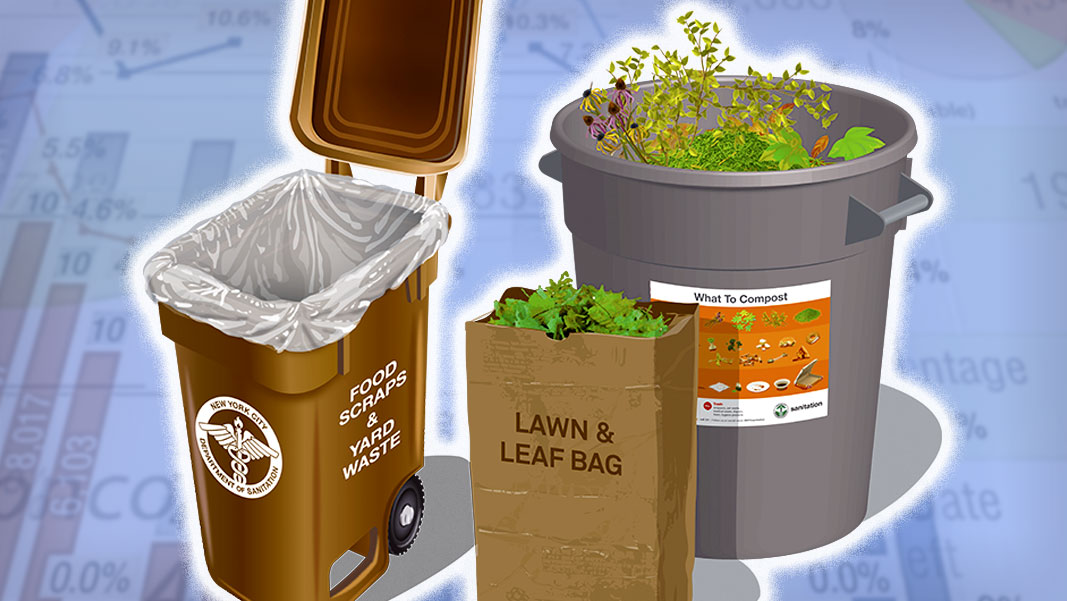
New York City’s mandatory curbside organics collection program is entering a new phase, offering a real-time case study in the challenges of scaling food waste diversion in large, dense urban environments. Launched citywide in 2024, the program requires residents to separate food scraps for weekly collection, with the goal of reducing landfill disposal and methane emissions. While participation is increasing, enforcement and education remain ongoing challenges.
Under the program, collected organics are managed through a mix of composting and anaerobic digestion, with some material converted to energy and some processed into soil amendments. Enforcement was initially set to begin last April, but fines were largely paused under then-Mayor Eric Adams, except for repeat violations in large buildings. In early 2026, the city resumed issuing summonses across building types under Mayor Zohran Mamdani’s administration.
According to the NYC Department of Sanitation (DSNY), 330 noncompliance summonses were issued between January 1 and January 21, 2026. This is far fewer than the roughly 4,000 summonses issued during a brief enforcement window in 2025. City officials have emphasized that changing resident behavior takes time, particularly in a system as large and complex as New York City’s.
Current participation data underscores both progress and distance still to cover. A recent DSNY report found that 7.2% of compostable material was placed in the correct bin during the last fiscal year, up from 4.2% the year prior. While the increase is notable, experts caution that much higher participation is needed for economic efficiency. Samantha MacBride, former director of research and operations at DSNY, has estimated that participation needs to reach at least 30% for the program to operate cost effectively.
Advocates also warn that inconsistent rollout and funding uncertainty have complicated education efforts. Christine Datz-Romero, co-founder of the Lower East Side Ecology Center, pointed to budget cuts in 2024 that temporarily reduced support for community composting programs, even as the city expanded mandatory collection. While some funding was restored by the City Council, nonprofit organizations remain sensitive to shifting priorities.
MacBride and others have stressed the importance of aligning enforcement with outreach and operational realities. Without adequate education, building maintenance staff may shoulder the burden of sorting material after disposal, increasing costs and frustration without improving outcomes.
Lessons for Other Cities
New York City’s experience offers several lessons for municipalities considering mandatory organics diversion with limited enforcement resources.
First, education and infrastructure must scale alongside mandates. Requiring separation without sustained investment in outreach can slow participation and undermine program efficiency.
Second, enforcement works best when phased and targeted. Early pauses and gradual escalation may help cities refine operations and identify barriers before widespread penalties are imposed.
Third, community-based organizations play a critical role in building trust and understanding. Partnerships with nonprofits that provide hands-on composting education can accelerate behavior change more effectively than enforcement alone.
Finally, cities benefit from studying waste flows at the neighborhood level. Tailoring strategies to building types, collection routes, and local conditions can improve participation while reducing operational strain.
As more municipalities adopt food waste diversion requirements, New York City’s evolving program illustrates that mandates alone are not enough. Durable success depends on aligning policy, funding, education, and operations in ways that residents and workers can realistically support over time.