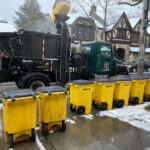

Top: Photo courtesy USCC
The US Composting Council’s (USCC) first compensation white paper describes an industry adding people and raising pay faster than it can define the jobs. Bureau of Labor Statistics (BLS) data cited in the report show employees and establishments under the composting industry code both up about 50% since 2022, with average weekly wages up 34%. Underneath those headlines sits a survey of just 20 organizations and a frank admission from USCC that the benchmarking project did not go as planned.
Respondents were mostly private companies (70%), split evenly across revenue bands and spread over 10 states, with New York and Washington the most common at 20% each. Many struggled to fit their staff into standardized job titles because employees often hold hybrid roles such as operator and laborer, or safety and human resources. USCC brought in Compensation Resources to make sense of what came back. Executive Director Linda Norris-Waldt said in announcing the report that “many compost organizations are still fully in growth mode with many employees filling hybrid, dual-duty positions.”
A 50% Growth Story With an Important Caveat
The report’s most striking headline is the roughly 50% growth in both employees and establishments under the composting industry code since 2022. But that figure comes with an important caveat.
BLS counts roughly 1,500 composting employees at about 120 establishments, against industry estimates of 2,000 to 3,000 facilities. In 2022, a USCC-led initiative established a dedicated North American Industry Classification System (NAICS) code for compost manufacturing. “The newness of the NAICS code is a key factor here,” Norris-Waldt said. Because BLS data lean on state unemployment tax filings, she explained, “any composting facility who registered more than four years ago and hasn’t updated their NAICS code here wouldn’t be counted.” (The previous NAICS designation for Composting Manufacturing was 325311-Nitrogenous Fertilizer Manufacturing.)
The data also include only private businesses that report composting as their main activity. “This would exclude any municipal program and/or company that may have another function they report under,” she said.
Neither the report nor USCC says how much of the 50% rise reflects new hiring versus facilities updating their codes, and the report itself flags a sharp wage spike in the fourth quarter of 2024 as possibly the product of outliers. Norris-Waldt sees the gap as a chance to improve the count, calling it “a good opportunity to tell USCC-member composting facilities to update their NAICS codes in their unemployment tax filings so we can get more accurate data.”
USCC plans a follow-up economic study in 2027 using 2025 facility data, after a 2021 study found five-year growth of 55% in facility numbers and 83% in tonnage processed. The white paper’s cover letter looks ahead to repeating the compensation benchmark in 2030.
Salaries, Benefits and Training
Where at least five organizations answered, the report offers average salaries. Compost facility operators and managers top the list at $82,744, followed by heavy equipment mechanics at $75,122, equipment operators at $59,806, haulers at $55,798 and sorting and contamination control specialists at $53,218.
On raises, 41.7% of respondents give both merit increases and cost-of-living adjustments and another 33.3% give cost-of-living adjustments only, which average between 4.1% and 4.4% across executive, management and staff groups.
Benefits look thinner. Against published employer surveys from CompData, KFF and the Society for Human Resource Management, respondents offered fewer paid days off at hire (7.4 versus 10.6), fewer retirement plans (60% versus 93.3%) and a smaller average employer match (3.5% versus 5.9%). Those benchmarks cover employers generally rather than composters, and insurance responses were too sparse to report.
Where composters do invest is in skills. Among respondents, 65% pay for staff to attend industry conferences and workshops, 55% cover online courses and webinars, 40% cover certification and licensing fees and 30% offer tuition reimbursement, with a reported maximum of $4,313.
The paper describes managers in a growth-phase industry as often making decisions on the fly, and Norris-Waldt framed the training spend as a deliberate choice. “We are training up our industry because we are still new and growing,” she said. USCC’s own member survey shows professional development and training as “one of the top two things members look for from USCC, the other being advocating for good compost policy.”
USCC’s first compensation report gives operators directional comparisons from a small sample, along with a practical to-do for any facility registered years ago, which is to check the NAICS code on its unemployment tax filing.
Read the USCC Compensation white paper here.