
Top Photo: From the BioCycle archives
The US Composting Council (USCC) is pushing back on proposed changes to a federal conservation practice that has become an increasingly important pathway for moving biosolids compost onto agricultural lands.
USCC submitted comments to the U.S. Department of Agriculture’s Natural Resources Conservation Service (NRCS) opposing two proposed revisions to Conservation Practice Standard Soil Carbon Amendment Code 336. Under the proposed standard, compost manufactured with biosolids would be excluded, and eligible compost would need a carbon-to-nitrogen (C:N) ratio of at least 20:1. NRCS opened Code 336, along with dozens of other conservation practice standards, for public comment this year under Docket NRCS-2026-0100.
Code 336 covers the application of biological soil amendments, including compost and biochar, to agricultural, rangeland and forest soils. When the Soil Carbon Amendment is included in a producer’s conservation plan through programs such as the Environmental Quality Incentives Program (EQIP), the producer may qualify for financial assistance to apply the amendment. The national standard became permanent in 2022 after several years as an interim conservation practice. According to USCC, NRCS documents now show state-level Code 336 materials across all 50 states, as well as Puerto Rico and the U.S. Virgin Islands.
That expansion represents a potentially significant agricultural market for compost manufacturers. USCC is concerned that narrowing the types of compost that qualify could limit that opportunity without necessarily improving product quality. “Ensuring that EPA compliant classes of biosolids can do their job of sequestering carbon on ranchland and working lands is enormously important,” said Linda Norris-Waldt, Executive Director of USCC.
USCC is recommending that NRCS evaluate finished compost based on its characteristics, safety, quality and intended use, provided the material meets applicable federal and state requirements, rather than categorically excluding compost based on feedstock. The organization is taking a similar position on the proposed 20:1 C:N threshold. C:N ratio can help indicate how compost may behave when applied to soil, but USCC says it should remain one parameter among several, not become a pass-or-fail measure of compost maturity or quality.
USCC also recommended that the revised standard incorporate compost-specific laboratory proficiency requirements and the nationally recognized definition of compost developed by the Association of American Plant Food Control Officials.
More Than $45 Million Spent Through Code 336
Code 336 is also becoming more consequential as spending under the practice grows. During a 2025 American Farmland Trust webinar, Brandon Smith, who worked on the development of Code 336 while at USDA and is now with the American Biochar Initiative, presented NRCS Financial Assistance Dashboard data showing cumulative spending on the practice through July 2025.
“We’ve had at least $45 million spent,” Smith said of Farm Bill and Inflation Reduction Act funding flowing through the practice since its initial rollout.
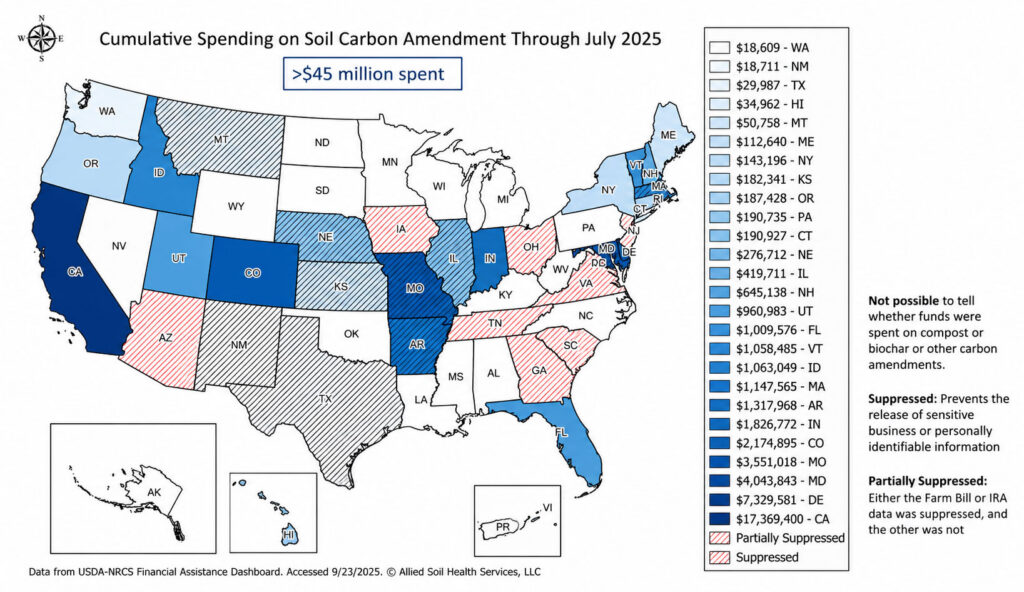
Source: USDA-NRCS Financial Assistance Dashboard. Click here to expand this image.
California accounted for by far the largest amount shown on the map, at approximately $17.4 million. Delaware followed at roughly $7.3 million, Maryland at $4.0 million, Missouri at $3.6 million and Colorado at $2.2 million. Several states had spending that was partially or fully suppressed to protect producer confidentiality, so the public figures do not capture all expenditures.
It’s important to note that NRCS reporting does not distinguish whether Code 336 dollars were spent on compost, biochar or another eligible carbon amendment. “It’s not possible from these reports to tell,” Smith explained. Actual spending could be considerably higher because of the suppressed data, although that estimate was his own interpretation rather than an NRCS total.
That makes it difficult to say precisely how much federal funding Code 336 has directed toward compost purchases. What is clear is the program’s reach and the scale of spending. A conservation practice that began with adoption in only a couple dozen states has grown into a nationwide tool through which farmers and ranchers can receive financial support for soil carbon amendments.
The proposed changes now raise a bigger question for the composting industry. What should determine whether a compost product qualifies for that investment? USCC’s position is that the answer should be the quality and performance of the finished compost, not simply what went into making it.