
Top Photo: Courtesy of Key City Compost
Virginia local governments now have authority to require large generators of food waste to separate organics from their trash and divert the material from disposal. Senate Bill 226, approved May 14, 2026, puts the decision to establish those requirements in local hands. Each locality must adopt an ordinance before businesses face obligations under the new framework.
For composters, a key provision ties mandatory participation to proximity. A locality adopting an ordinance must require businesses generating at least one ton of organic waste weekly to compost that material at a permitted facility within 30 miles. There is an exception: A business can demonstrate in writing that the facility will not accept its organic waste.
That distinction matters. A nearby facility may be permitted, but its ability to receive a particular generator’s material will help determine whether the composting requirement applies.
The law also gives localities several diversion options to incorporate into their ordinances, including food waste prevention, donation of edible food, on-site organics recycling, agricultural uses such as animal feed, and processing at organics recycling facilities or anaerobic digesters. Covered generators include supermarkets, convenience stores, schools and institutional cafeterias. Local ordinances establish the threshold for participation, and generators may seek hardship waivers.
Enforcement begins with a warning. Subsequent violations carry civil penalties of $250, $500 and $1,000, with each day of noncompliance constituting a separate violation.
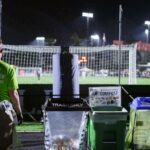
The legislation addresses schools, too. It expresses the General Assembly’s intent that new public school facilities, along with improvements and renovations, include cafeteria sorting stations for trash, recyclables and organics, plus a sink for liquids. Earlier bill versions included a purchasing preference for locally produced compost. That provision was omitted from the enacted legislation.
In Virginia, the impact of the legislation will depend on how many localities adopt ordinances, the number of food waste generators brought into diversion programs, and whether existing collection routes and processing facilities have the capacity to manage additional material. Local requirements could provide a more dependable supply of feedstocks, giving haulers and composters greater confidence when considering expansion. But that opportunity will depend on how ordinances are written and implemented. Generator education, clear acceptance standards and reliable collection service will need attention alongside enforcement.
Businesses already separating food scraps have useful experience to bring to those discussions. Their collection arrangements and contamination challenges can help local officials understand what implementation requires. Virginia has established the authority. Local decisions will determine what happens next.