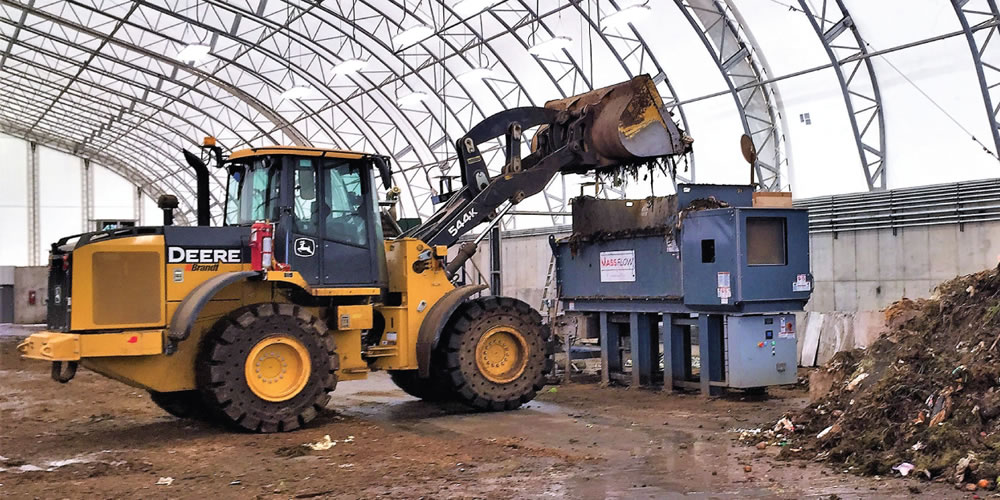
Top Photo: From BioCycle Archives. Nova Scotia Composting Operations.
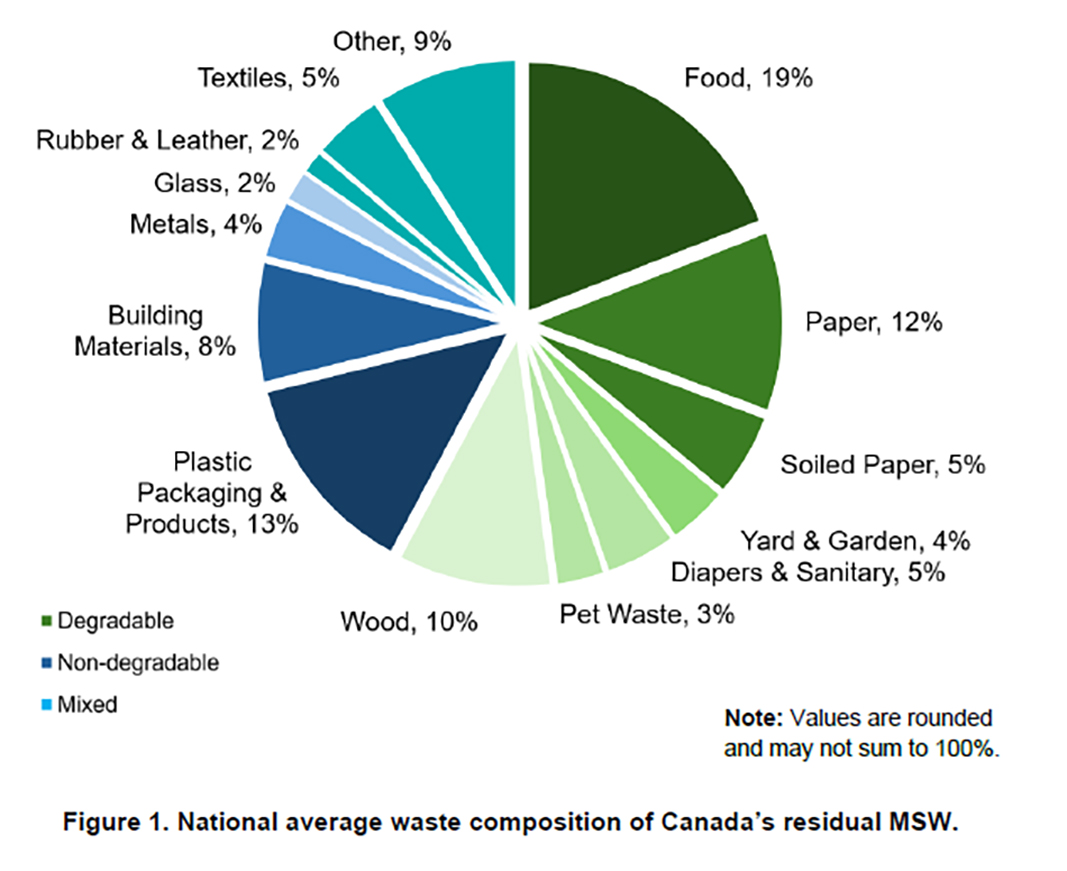
Environment and Climate Change Canada’s new National Waste Characterization Report shows that food waste remains the largest material in the country’s residual municipal solid waste stream, accounting for 19% of what is still being thrown away, while only 24% is diverted nationally (Figure 1). That gap between generation and diversion is one of the clearest takeaways from the report, and it points directly to the need for more collection access, processing capacity and organics recycling infrastructure.
Figure 1. National average waste composition of Canada’s residual MSW
Source: Taken from the National Waste Characterization Report (NWCR)
The report, built from roughly 150 waste audits conducted across provinces and territories between 2008 and 2024, found that degradable materials, food, paper, wood, diapers, soiled paper, yard waste, and pet waste, make up 58% of everything Canadians send to landfill or incineration. Food alone accounts for a third of that biodegradable share, and 5.0 million tonnes of it was landfilled in 2022.
Compare that to paper, which achieved a 52% diversion rate, or yard and garden waste at 51%. Both are materials with decades of established curbside and drop-off infrastructure behind them. Food waste diversion, by contrast, is still closer to where paper recycling was several decades ago. For BioCycle readers tracking where the next wave of capacity investment needs to go, this is the number that matters most.
Nova Scotia Is the Proof of Concept
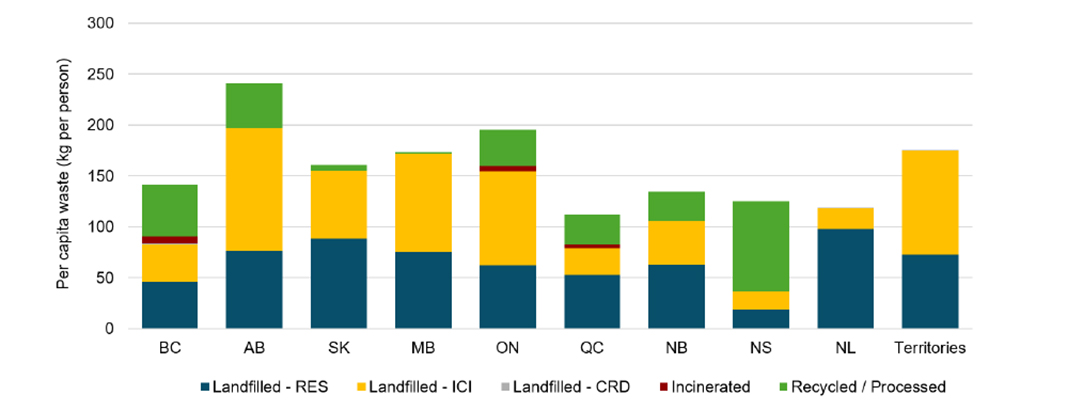
The report credits Nova Scotia’s long-standing organics disposal ban with producing the lowest per capita food waste disposal rate in the country. The province posted a 71% food waste diversion rate, by far the highest of any province or territory. British Columbia came in second at 41%. Every other jurisdiction fell somewhere between 1% and 29% (Figure 2).
The report suggests that technology and collection models already exist across the country. What varies is policy commitment and program maturity. A ban paired with sustained investment in processing capacity appears to move the needle more than any other single factor identified in this dataset.
Figure 2. Per capita quantities of food waste landfilled, incinerated and recycled/processed in Canada by sector across provinces and territories (2022)
Source: Taken from the National Waste Characterization Report (NWCR)
Plastic Packaging Waste On the Rise
While food waste carries the largest volume, plastic packaging and products present a different kind of problem for composters. It’s now the largest non-degradable category in Canada’s waste stream at 13%, and its diversion rate is a mere 10%, the lowest of any material tracked in the report. Between 2016 and 2022, plastic packaging’s share of the residual waste stream increased consistently, alongside textiles and diapers and sanitary products, even as food waste’s share declined.
Where the Waste Actually Comes From
The sector breakdowns are useful for anyone scoping new collection programs. Residential waste is 22% food and 13% plastic packaging. Industrial, commercial, and institutional (ICI) waste mirrors that food percentage almost exactly at 22%, but carries more paper (22%), and more plastic packaging (16%). Construction, renovation, and demolition waste is a different animal entirely, dominated by wood at 39% and building materials at 36%, with organics playing a minimal role.
The report shows that businesses, institutions, and other commercial generators are producing food waste at nearly the same rate as households, but municipal ICI waste audits likely undercount the true total, since private haulers handle much of that stream and their data isn’t captured in the study. The real opportunity in commercial food waste diversion may be larger than even this report shows.
Canada’s organics recycling story right now is really two stories. Paper and yard waste diversion have matured. Food waste diversion has not, and it represents the largest remaining pool of divertible material in the country’s waste stream. Nova Scotia’s numbers show what’s possible when policy and infrastructure investment align. The rest of Canada has a long runway to close that gap, and closing it is where composting and anaerobic digestion capacity will need to grow fastest over the next decade.