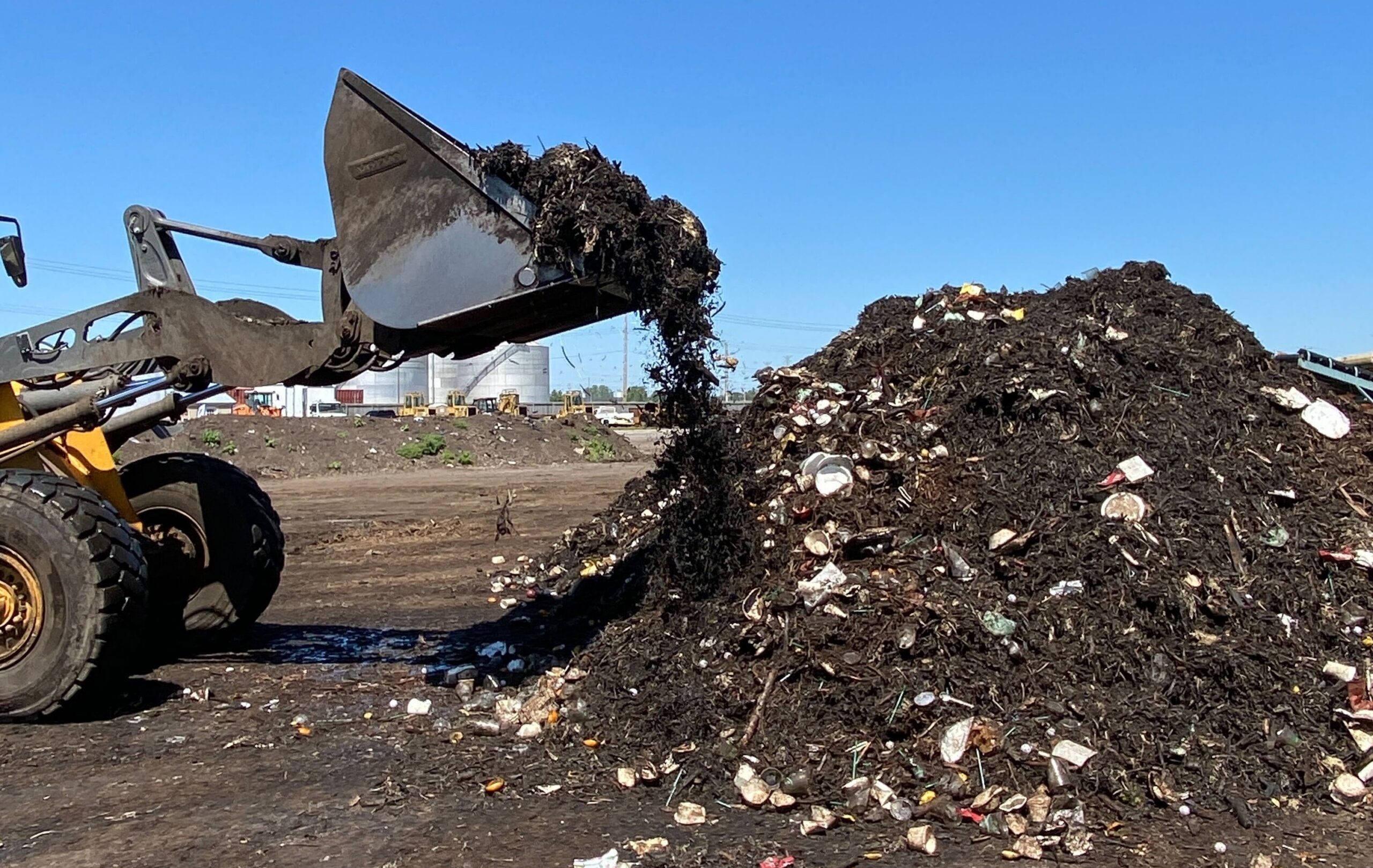
Top Photo: Compostable packaging dosed into a compost pile with food waste.
Emily McGill, Liv Johansson and Susanna Carson
While composters and compostable packaging producers are often aligned in their goals of promoting healthy compost and healthy soil, there is a gap between what products get certified as compostable via lab testing and what gets accepted and processed into compost in the field. This rift confuses consumers and businesses, frustrates composters and certified compostable product brands, and puts policymakers in a tricky position.
How do certified compostable items break down in diverse, full-scale composting facilities? The Compostable Field Testing Program (CFTP) was founded by the Compost Research & Education Foundation and BSIbio Packaging Solutions to answer this question. A grassroots, open-source research project, the CFTP has collaborated with composters across North America to gather field test results from a wide range of composting facilities and conditions.
This article is Part III of a four-part series. Part I offers additional background on the CFTP, and Part II provides detail about field test methods for evaluating compostable products. This Part III delves into the field testing results bolstered by a significant new data release, and previews the CFTP’s upcoming Field Report. A future and final Part IV article will dive into the implications of the present results and the future of field testing for CFTP.
In fall 2024, the CFTP launched its open-source data dashboard with 14 field trials’ results. As of April 2026, the webpage now hosts results for 23 field tests (21 mesh bag trials and 2 dose trials) across North America. The results of the 21 publicly-available mesh bag trials are the basis for the results shared here and in the Field Report.
Field Testing Program Methods
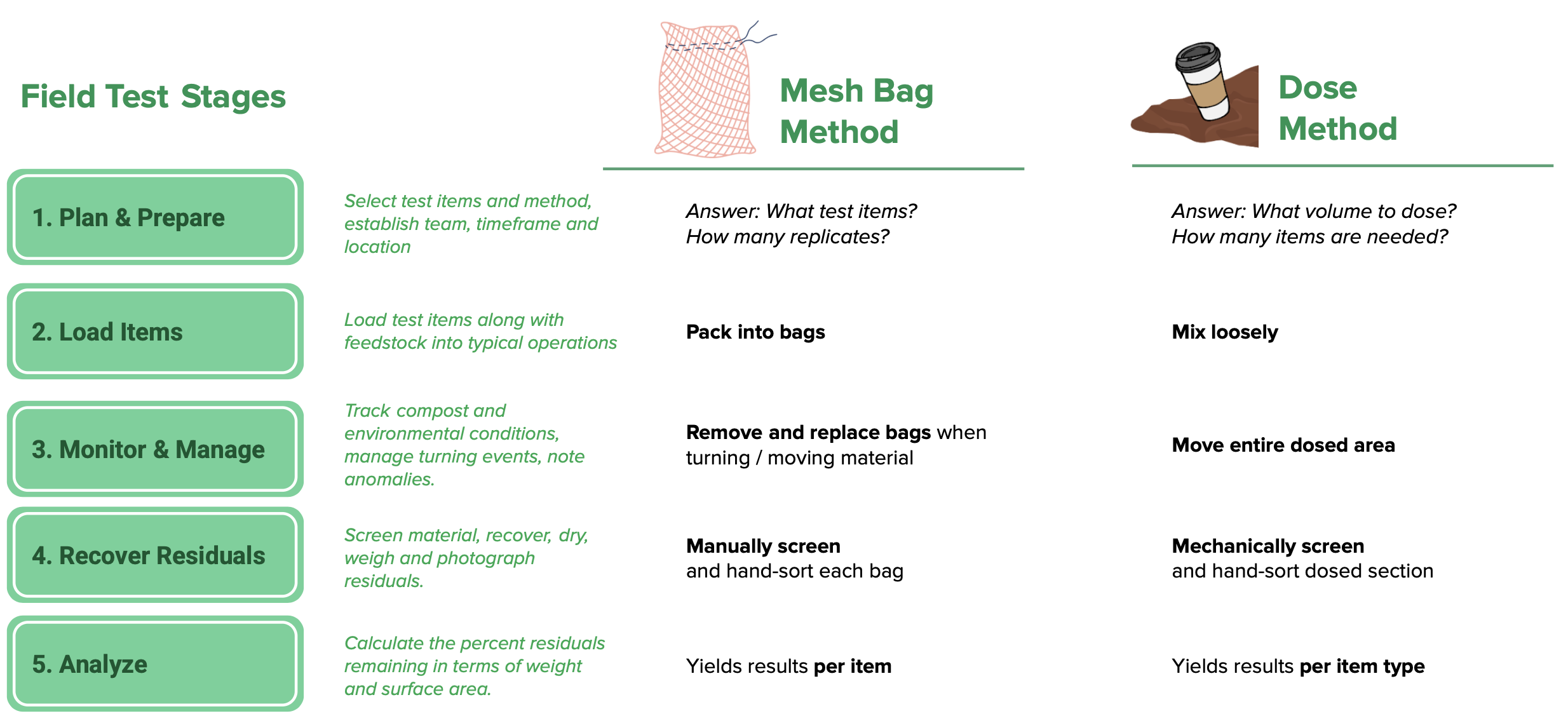
Two field test methods have been used and refined over time: the contained or “mesh bag” method and the dose method. CFTP’s methods formed the basis of the ASTM International standard test methods ASTM D8618 (Dose) and ASTM D8619 (Contained), published in summer 2025.
Click image to enlarge.
Learn more about these methods in Part II of this article series.
Metrics
The field test methods require collection of both disintegration and compost operating conditions data. For disintegration, field testing provides a macro-level assessment evaluating test item residuals present in the overs fraction of a ¼” screen.
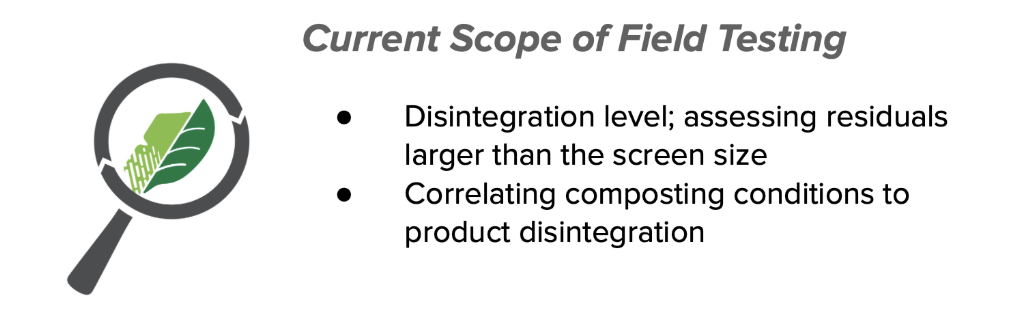
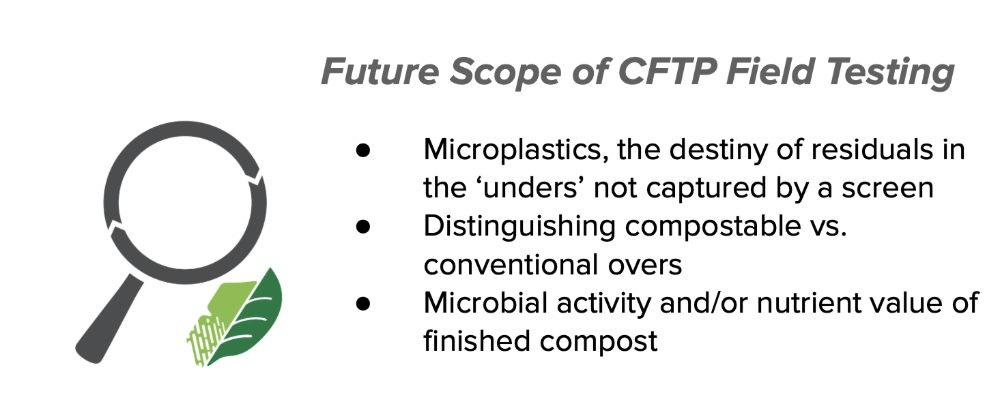
Residuals in the fines fraction have not historically been assessed, though persistent and increasing inquiries about microbial assays, PFAS, and microplastics are prompting the CFTP to consider seeking funding to answer these more challenging questions.
What’s Been Tested
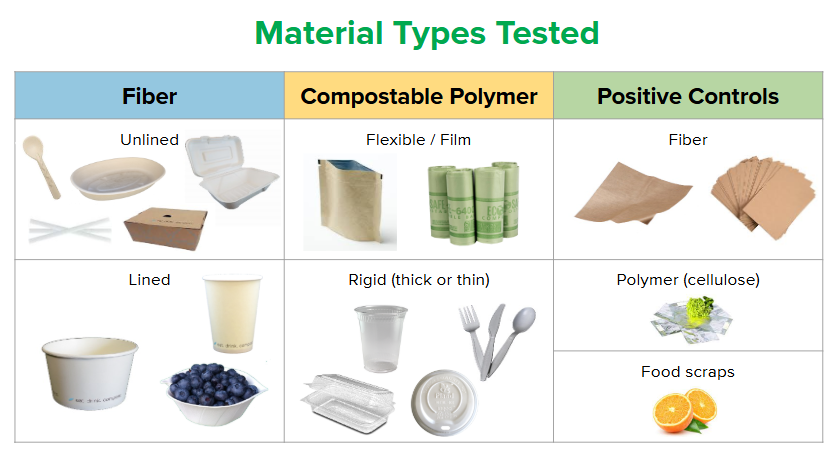
Test items are divided into five broad material categories:
- Unlined Fiber
- Lined Fiber
- Flexible/Film Compostable Polymers
- Rigid Compostable Polymers (further divided by thickness)
- Positive Controls
The CFTP’s test sites receive a baseline test kit which includes products with known formulations and formats to better compare results between sites. The current test kit features a PLA-lined paper bowl, crystallized PLA (CPLA) hot cup lid, PLA cold cup, CPLA spoon, PLA-coated bagasse bowl, uncoated paper tray, lined paper box with lid – all BSIbio’s BEISICS brand – and a kraft paper control. Facilities are asked to include half of an orange peel as a food scrap positive control.
Custom items added by participating composters include bin liners, straws, wooden cutlery, and a broad variety of different material types across each general category.
Results From the Field
Key Takeaways
The data shows that certified compostable products break down under the right composting conditions, which are further explained in the following section. This applies for both material types: fiber-based and certified compostable polymers.
The data also clearly shows that those ideal composting conditions do not exist everywhere, or even in every pile at the same site, and the degree of product disintegration varies accordingly. Today’s data set, encompassing the results of more than 2,000 individual samples via the mesh bag method and over 33,000 in dose, is sufficient to show compelling disintegration trends that map onto variations in temperature, moisture, trial duration, and processing technology type.
Disintegration Data
Assessing disintegration by mass (aggregating the wet and dry weights of residuals), CFTP’s mesh bag test data shows that, on average, compostable polymers left no residuals (i.e., disintegrated completely) in 93% of samples, and fiber materials left no residuals in 70% of samples.
These averages tell an incomplete story, however, as the dataset has high variability across material types and across trials.
CFTP uses boxplots on its public data explorer webpage to visualize the dataset. The boxplot below shows the results by high-level material categories – fiber, compostable polymer, and positive controls – for 21 mesh bag trials. Box plots indicate the distribution of a data set. If the box is longer and the whiskers extend further along the y-axis, the data spread is greater. Smaller boxes show less variability in the results.

Click image to enlarge.
Compost Process Conditions Data
Compost process conditions are interdependent, e.g., an increase in temperature may reduce moisture through evaporation, while turning a pile will temporarily spike oxygen and reduce temperature. No condition stands alone as an absolute predictor of effective breakdown for compostable products. The three process conditions that appear to correlate most closely with disintegration outcomes are temperature, moisture, and trial duration.
Temperature
Daily temperature measurements are requested in CFTP field trials. Field trials have taken place during all seasons across different geographies, and sites are encouraged to take readings near the site of the mesh bags. The line chart below displays the moving averages of temperature data across field trials that reported a minimum of weekly data.
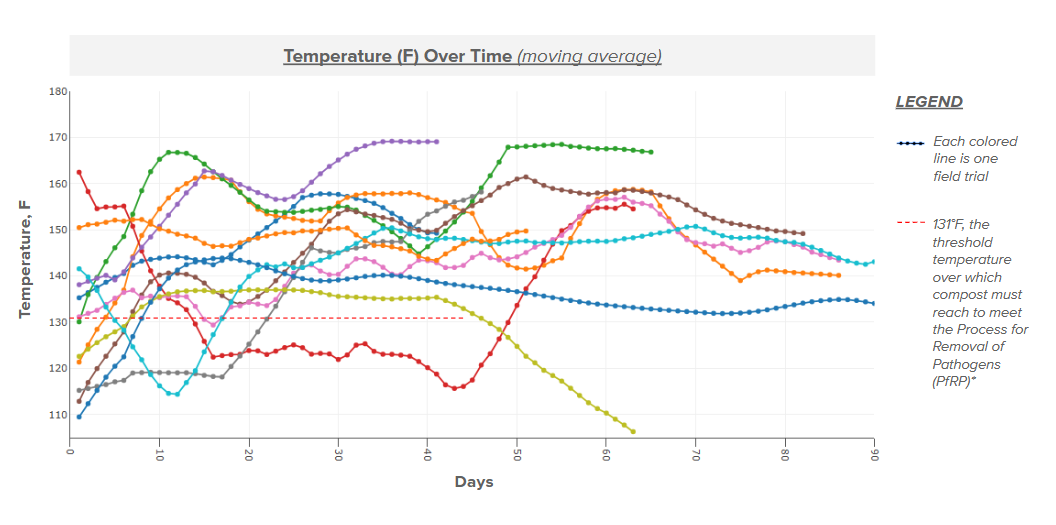
Click image to enlarge. *The Process to Further Reduce Pathogens mandates that compost piles must reach temperatures of at least 131°F (55°C) for at least 3 days in a row in a static pile system, and at least 15 consecutive days in a windrow system that is turned at least 5 times in that period.
Of the 21 mesh bag field trials, 14 trials reported sufficient temperature data to be used in comparative analysis. Of these, not all field trials tracked temperature or moisture data past 45 days, so the average temperature across the first 45 days is used for the purpose of distinguishing trends.
Moisture
Test sites are asked to track pile moisture on a weekly basis via a hand squeeze or oven-drying test. Ideal moisture content ranges described in The Composting Handbook are 50% to 60% throughout active composting, though it is expected that composters will allow piles to dry out to <40% by the end of curing to allow for easier screening and distribution of finished composts.
Field test sites reported weekly moisture levels across composting facilities spanning from under 30% to above 70%. Some sites report high pile moisture for weeks, while others drop quickly.

Click image to enlarge.
Analyses of disintegration trends by moisture are limited by the available data. Owing primarily to limitations in staffing, not all sites were able to report weekly moisture information. Of the 21 mesh bag tests, 13 reported sufficient moisture data for comparative analysis.
Trial Duration
CFTP’s field tests are designed to track disintegration through the typical residence time of the compost site, from receipt of feedstocks through to the end of curing and preparation for sale or distribution. We aim to follow the composter through their typical composting process instead of imposing a standard testing timeframe.
The histogram below shows how all trials are distributed by the number of days, from 40 days to over 190 days.

Compost Processing Technology
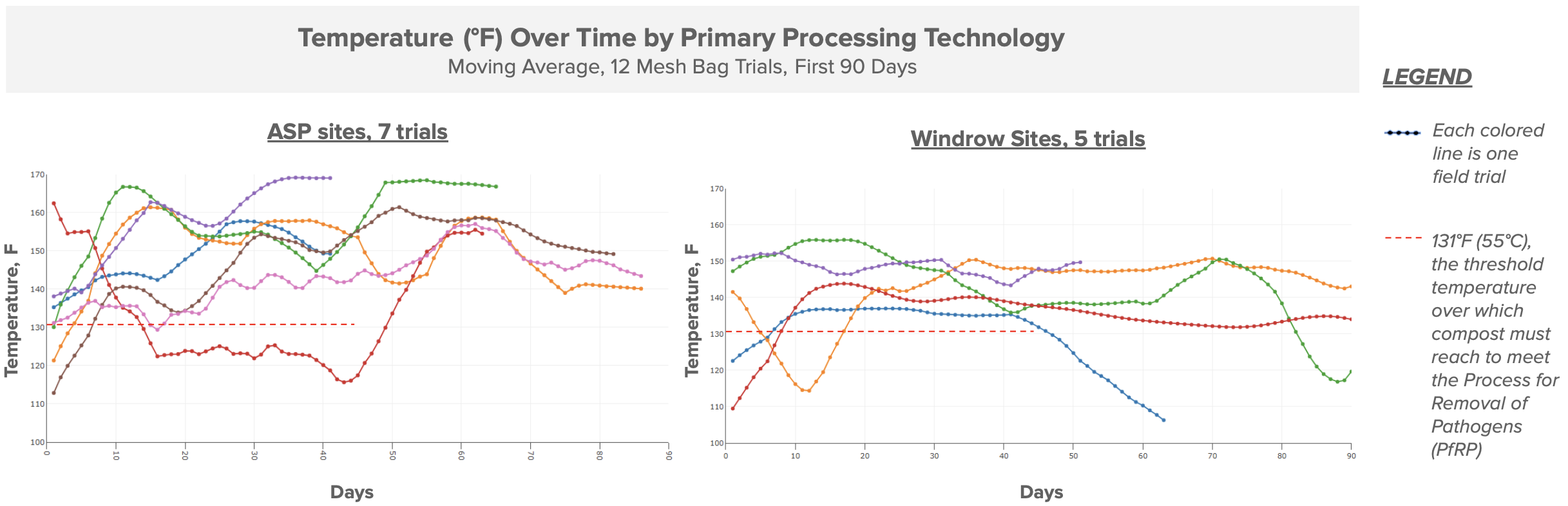
The two categories of compost technologies in CFTP’s mesh bag data are aerated static pile (ASP) and open-air turned windrow (windrow). Windrow facilities reported lower temperatures – both averaged at start and over the duration – with longer residence times, and lower average oxygen levels than ASPs.
Trends in Compost Process Conditions on Effective Compostable Polymer Disintegration
Temperatures averaging above 141°F (~60.5°C) and moisture levels averaging above 50% in the first 45 days of composting improve breakdown for rigid compostable polymers. These trends apply regardless of compost processing technology and trial duration.
Rigid compostable polymers break down better when composted in piles at or above 141°F (~60.5°C). Temperatures below 140°F still result in near-total disintegration for thinner, rigid compostable polymers (e.g., cold cups), while thicker, more heat stable items (like cutlery) show more residuals at temperatures below 140°F.
The impact of moisture on the disintegration of compostable polymers appears to be more complex. Moisture levels at or above 50% appear to correlate in consistent disintegration. However, in one trial where average pile moisture was 57% and average pile temperature was lower (129°F), high levels of biopolymer residuals were found at the end of testing. More research is needed to further understand the relationship between temperature and moisture and biopolymer disintegration in a composting environment. The results emphasize the limitations of considering any compost processing condition in isolation.
The breakdown of compostable polymers is not as sensitive to trial duration as it is to temperature or moisture. When residuals are assessed in trials that lasted between 45 to 90 days, the disintegration results are very similar to those that went more than 90 days. And, in fact, there is a notable trend of CPLA showing more residuals in windrows than ASP systems, which tend to have a longer average residence times compared to ASP processes. This indicates that variables other than residence time have a greater impact on biopolymer disintegration.
With these results taken together, the working theory is that compostable polymers, such as PLA, undergo disintegration through two complementary and consecutive mechanisms: first chemical degradation (hydrolysis), then microbial biooxidation. Hydrolysis is catalyzed by high temperature and moisture in the feedstock mix. The water and heat work together to begin splitting the polymers into lactic acid oligomers and monomers (Limsukon, et al., 2023). These shorter-chain molecules are then consumed by the microbes living in the liquid films surrounding compost particles. If the moisture and temperature conditions for hydrolysis aren’t met within the composting environment within the initial, thermophilic phase of the process, these materials have a harder time breaking down, even with extended process durations.
Compostable polymer film formats represent a smaller portion of the CFTP’s data set, and are discussed in the Field Report and viewable on the webpage.
Trends in Compost Process Conditions for Effective Fiber Disintegration
Temperatures averaging below 145°F (~62°C) and moisture levels averaging above 50% in the first 45 days of composting improve breakdown for fiber items, with more disintegration in windrow than ASP systems.
When comparing the effects of temperature, fiber items break down more completely in a lower temperature composting environment, below a 45-day average of 145°F (~62°C). Meanwhile, moisture contents over 50% facilitate higher rates of disintegration.
The working hypothesis for the disintegration of fiber-based products is that they are rich in lignins and cellulose, which are not bioavailable compounds for thermophilic microbes to consume. These fibers are more effectively decomposed by fungi that thrive in cooler, wetter conditions and are largely inactivated by temperatures over 131°F. Relatively cooler, wetter piles – while still thermophilic – may have more fungi-consuming fibrous materials sooner. Hotter piles may also be prone to excessive drying through evaporation, and that drying effect could further depress fungal activity over time.
There appears to be improved breakdown across all fiber categories – lined, unlined, and fiber controls – in field tests with longer composting durations. The data also shows that fiber products, regardless of material type, show more total breakdown in windrow systems than ASPs. As previously noted, windrow systems tend to have lower average reported pile temperatures and longer composting durations than the ASPs in CFTP field trials. The graph below shows the average temperatures for ASP and windrow sites for 12 of our trials.
Click image to enlarge.
If the hypothesis about fungal-dominant decomposition reflects reality, then these results for trial duration and technology types are also intuitive, as the fungal decomposition of lignin and cellulose-rich materials takes more time than bacterial decomposition on readily-bioavailable feedstock materials.
These hypotheses deserve significantly more investigation as fiber-based products are increasingly being sourced as alternatives to compostable polymers. Future CFTP testing will focus on clarifying the relationship between moisture content and compostable product disintegration.
Advancing Field Test Methods
The CFTP’s founding data set shows that certified compostable products show effective disintegration outcomes under a range of operating conditions. The data set also shows the critical importance of assessing disintegration results across a variety of composting operations to capture the diversity of composting infrastructure serving our communities today.
While the CFTP’s data set is a strong start, implementing standardized field testing methods targeted at data gaps will enhance our understanding of the ideal range of facility conditions required to consistently and reliably process different material types. With rigorous methods in the now-published test methods under ASTM International, and the CFTP’s complementary detailed methods soon to be in the public domain, the future of field testing research is bright.
Learning from historical precedent, future CFTP testing will be restricted to field tests at sites with capacity to perform the additional monitoring required to fill our data gaps. The CFTP is looking for partners in this work. Please reach out to CFTP Program Manager, Liv Johansson, to learn more about participating in our field test trials.
What Comes Next
Field testing is one piece of a much larger puzzle. It fits in at the intersection of compost science and materials science, and is key to the development of comprehensive and effective pollution prevention strategies that truly serve our communities and composters.
The upcoming CFTP Field Report publication marks the close of CFTP’s founding phase of exploratory research. Get on the CFTP’s mailing list to be the first to receive a copy of our report and stay tuned here at BioCycle for Part IV of this article series which focuses on the future opportunities for making use of the field research.
About the Authors
Emily McGill is the outgoing Program Director for the Compostable Field Testing Program (CFTP), via her role with BSIbio Packaging Solutions, one of the founding partners of the CFTP. Emily has directly facilitated or remotely supported over two dozen field tests across diverse compost sites, and helped to lead the development of refined and standardized test methods under ASTM International.
Liv Johansson is the Program Manager of the Compostable Field Testing Program via the Compost Research & Education Foundation. She formerly supported compost science, education, policy, and permitting at Engineered Compost Systems and served as a compost facility operator for the Woodland Park Zoo’s manure composting operation.
Susanna Carson is the founder and CEO of BSIbio Packaging Solutions (BSIbio), a compostable packaging distribution company, and Bésics® Packaging Corporation, a compostable retail products company. She has more than 30 years of education and work experience in environmental issues and business development in compostable food packaging. Susanna has served as Co-chair of the Product and Packaging Working Group of the National Zero Waste Council (2014-2017) and has been a topic expert for the Sustainable Packaging Coalition (2015, 2016). Her work with BSIbio co-founded the Compostable Field Testing Program in partnership with the Compost Research and Education Foundation (2017-present).