
Top photo: Diane Hazard with a worm at COMPOST2026. Photo courtesy of CREF.
Diane Hazard has been the Executive Director of the Compost Research & Education Foundation (CREF) for over four years. In early 2027, Hazard will step down, leaving CREF a stronger organization, primed for growth.
Hazard spent much of her career in biotech and pharmaceutical development. After over 20 years in that field, she took a break to focus on raising her son. During that break, she finally had time to plant a garden in her backyard. She was eager to grow tomatoes with the deliciousness she remembered from her childhood on a Pennsylvania hobby farm. The first year’s tomatoes came close. But by the third growing season, her unamended San Diego soil wasn’t up to the task. “Those tomatoes were nasty,” Hazard says. Realizing something was wrong, she took a master composter course that set her on a new trajectory.
Hazard started composting, and began teaching composting courses at the Solana Center for Environmental Innovation. “When it was time to go back to the lab, I didn’t want to go back. I was having too much fun playing in my yard.” Hazard says. She returned to school for a certification in sustainable business practices and eventually became the Solana Center’s education director — a role she held for about 10 years.
Hazard came to CREF as the organization’s first executive director since the organization spun off from the US Composting Council (USCC). When she took the job in 2022, CREF and USCC had separate boards but shared an executive director. Lorrie Rossiter, CREF’s Board Chair, remembers when the two organizations also shared a board. “We would adjourn from one meeting and step into the next,” says Rossiter, who recalls being one of the only women in the room when she joined USCC’s board in 1999. Today, she adds, there are many prominent women in the compost industry and more diversity overall.
When Hazard was hired, she and the board went through a strategic planning process for CREF. Additionally, they had to develop staff policies, write an employee handbook, transition to a new customer relation management system – essentially, develop all the administrative systems that had previously been shared with USCC. Kelsea Jacobson, who had worked with Hazard at the Solana Center, joined her at CREF to lead the education programs. The CREF team has since grown to eight people.

ICAW poster event in Sacramento, CA. Photo courtesy of CREF.
CREF Initiatives During Hazard’s Tenure
Under Hazard’s leadership, CREF continues to run its signature educational and research programs, including the Compost Operations Training Course (COTC), International Compost Awareness Week (ICAW), and supporting research on composting and compost use. CREF also stewards the Compostable Field Testing Program, which collects and aggregates data on compostable product disintegration under real-world conditions. Data is shared in an open-source online data dashboard.
Some of Hazard’s favorite moments with CREF have been watching the different ways in which people engage with the composting world, often for the first time. For example, graduate students present CREF-supported research at USCC’s conference each year. Hazard loves seeing the students light up at interest from the audience: “Seeing people spark and see their place in this world, it gets them excited for what else they can do,” she says. Hazard also loves seeing the art that comes in during the ICAW poster contest each year. “There’s so many ways to share your knowledge and your energy, and some people can do it through their art,” notes Hazard. “I’m so impressed at how beautifully people articulate this idea of why compost is wonderful.”
CREF has also launched several new initiatives during Hazard’s tenure. Updating the Test Methods for Composting and Compost (TMECC) is a major project that took years of fundraising to get off the ground. CREF hired two new team members to manage the update, which includes plans to have the manual translated into Spanish. After raising funds and surveying the industry, CREF is starting a research project on the value of compost for soil water retention. The project will develop an online calculator for water savings from compost application. This project is close to Hazard’s heart, since she got her start composting in San Diego and saw the difference compost could make in a dry climate with sandy soils. Finally, CREF added a new scholarship for COTC participants, the Cary Oshins Training Scholarship, in honor of CREF’s long-time education director, Cary Oshins. This scholarship supports participants who might otherwise not be able to attend a COTC.
Over the last four years, under Hazard’s leadership, CREF has raised over $2.4 million in funds to support its initiatives. Much of that funding has come from the compost industry, which directly benefits from CREF’s work. In 2025, on CREF’s 33rd birthday, it launched the 33 Club. Club members pledge to donate $33 per month to support CREF’s administrative and operating costs.
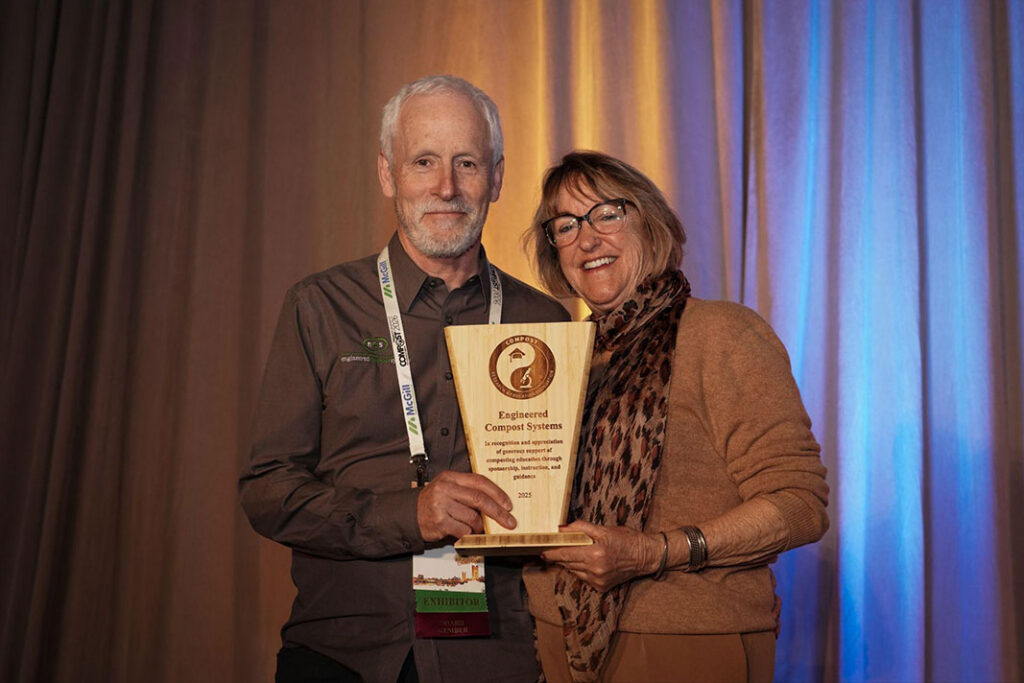
Diane Hazard giving an award at COMPOST2026.
What’s Next
The original strategic plan that Hazard helped to develop has run its three-year timeline. The next strategic planning process will launch once a new executive director is hired. The groundwork has been laid for continued growth at CREF to mirror growth in the compost industry. Hazard credits the many volunteers who dedicate time to the organization and its programs — especially the board. “Our board is engaged, interactive, and supportive,” Hazard says.. “They’ve made a really big difference. I’ve found that the people in nonprofits, particularly environmental nonprofits, just seem to be good people. I have met some of the most wonderful folks through this career path, and been feeding my soul as well.”
Of the CREF executive director role, Hazard says “it’s a passion job.” It’s also a unique opportunity to collaborate with USCC and other organizations, and the academics and practitioners moving the composting industry forward. Applications for the executive director position are being accepted through November 8th.
Meanwhile, Hazard is looking forward to playing in her own compost and spending more time in her garden.