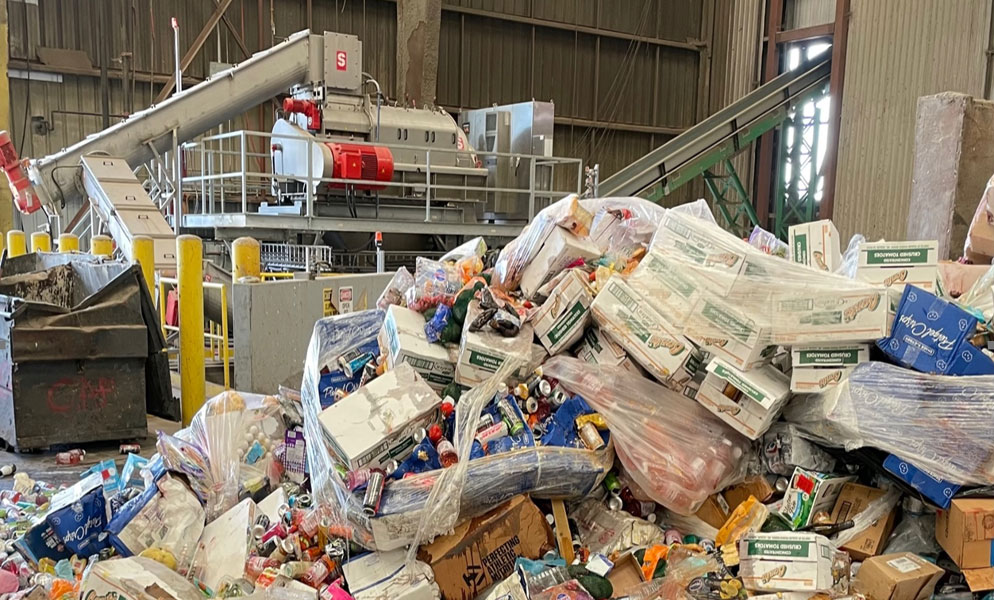
Top Photo: Packaged food and beverages staged ahead of loading into the bulk feed hopper. Photo courtesy of Van Dyk Recycling Systems
Wilfred Poiesz
In a rapidly growing organics diversion market, most buyers focus on simple organics depacking units and are not aware of the operational challenges in processing source separated food waste. Collection programs are diverse and materials are received from mostly commercial accounts in various types of bins, gaylords, pallets, roll offs or garbage trucks. To understand the differences between depackaging (depack) machine options, the first place to start is with vertical vs. horizontal designs.
Vertical vs. Horizontal Configuration
Vertical designs have a top loaded feed hopper that relies on gravity (and a loader operator) to feed the unit, creating a compact feed system. Vertical units work well for dry goods (bakery type) but tend to struggle with the usual food waste programs as heavy contaminants (glass or metals) will likely be pulverized and end up in the organic slurry. Horizontal designs can more easily handle heavy or large contamination by ejecting it laterally, but these depackagers require a feed system with a larger footprint.
Most depackers are initially procured based upon price and maximum throughput capacity, although most replacement units are ordered based upon slurry quality and ability to handle contamination, oversized items, frozen foods, green waste, along with being able to bulk feed the depacker.
A standard depacker and above ground elevated feed hopper is typically not a good match for a growing operation. The smaller feed hoppers on these machines, which need to be fed by loaders, are not congruous with handling of gaylord box tipping and or receiving and handling in bulk.
Van Dyk is well-acquainted with the waste hauling and recycling industry given its vast presence in the materials recovery facility (MRF) equipment and baler market. The company recognizes that horizontal depackers are better suited for operations that process bulk materials with high and low solids contents, ideally blending them in a bulk feed hopper system. The bulk feed hopper system allows some preprocess mixing, thawing of frozen materials, and the ability to hold bulk storage prior to high throughput production through the depacker.
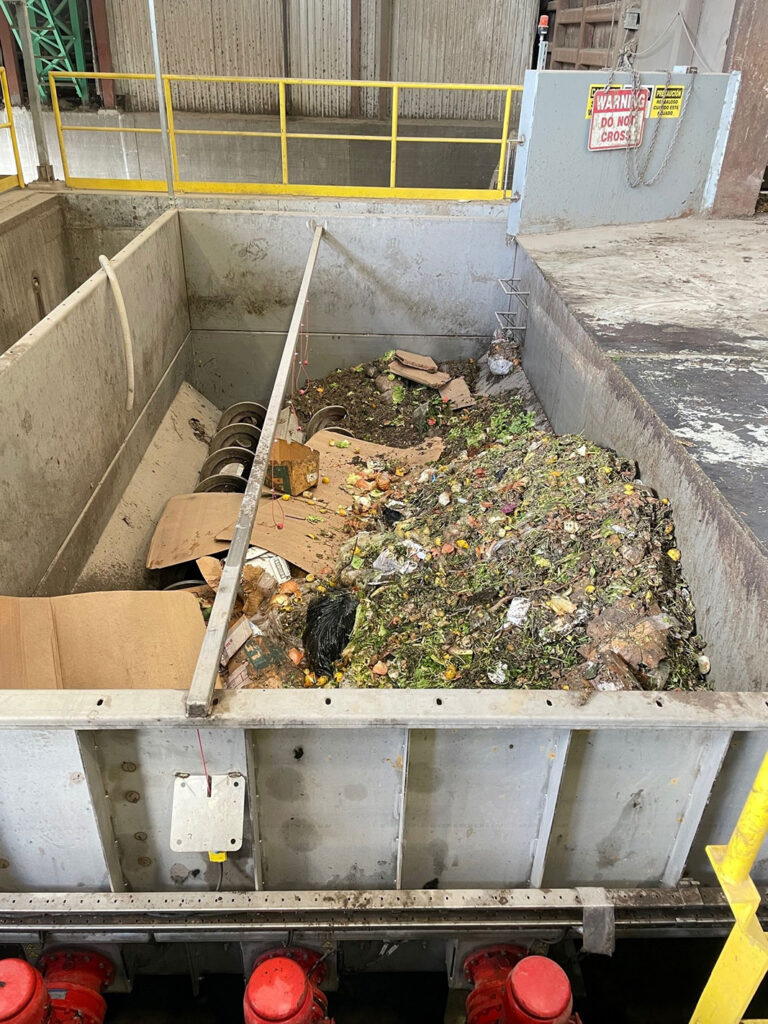
The automated feed hopper enables a continuous operating process as opposed to batch feeding. Photo courtesy of Van Dyk Recycling Systems.
The horizontal depackers from Dutch manufacturer Smicon are supported by an extra-large, automated feed hopper. This inground bunker with shaftless, non-wrapping augers provides a continuous operating process that eliminates the challenges associated with batch feeding a depack line. Material dumped on the tip floor can be shoveled into the bunker by a loader, or food waste collection trucks can back up and dump directly into the bunker. A continuous feed, rather than a batch feed, ensures consistent metering of material into the depacker, enabling operators to process steadily throughout a shift.
Screw Conveyors — Shaftless vs. Shafted
A shaftless screw design is at the heart of the bunker’s effectiveness. Borrowed from very heavy industrial operations (oil refineries, chemical, sewage, and water treatment plants), it features an auger screen design with no center shaft. Made to fit a troughed steel liner, after some initial wear-in it creates its own tight seal (steel liner can be replaced when needed). The tight seal allows conveyance of low-solids materials without the need for pumping water in to help liquefy or thin out what is being processed. The open space within the screw crushes and blends material well without jamming or wrapping. It is open ended (no bearing at the end of the screw) to eliminate the issue of wrapping or jamming and ensures continuous operation.

The shaftless screw design allows conveyance of low-solids materials without the need for pumping water in to help liquefy or thin out what is being processed. Photo courtesy of Van Dyk Recycling Systems.
Conversely, a shafted screw design (center shaft with an auger screw welded around) has much less open space, limiting its ability to handle bulk packaging. Fluids don’t transfer well, and more water is required to soften the product and push it through the smaller openings.
Van Dyk and Smicon recommend shaftless screws after switching to their use in 2018, finding them better for transporting bulk materials. The larger openings provide more room for initial liberation of bulk packaging, prevent wrapping and jamming, and are more effective at pushing material through.
To assist in contaminant removal ahead of the depacker, one California operation installed a stationary walking floor for visual inspection after the bunker but prior to the depacker. The walking floor reduces burden depth, singulating the material so that any bulky, non-organic contamination is easily spotted and removed. Another West Coast operator uses tip floor space as a staging area to remove any obvious contamination via loader before pushing accepted material directly into the feed bunker. Its Smicon depacker averages 100 to 150 tons/day of food waste slurry, which is then blended with green waste at its 600 tons/day anaerobic digestion facility.
High Volume, High Capacity
Most depacker tons/hour throughput rates are based upon canned food and drinks destruction. Those items are easy to process at high tons/hour (tph), with around 40 tph possible. The most important measures for depacking — liberating and minimizing organics in the packaging and non-organic contamination in the slurry — are best compared based upon processing a typical inbound mix of restaurant, grocery store and commercial food packaging accounts, which typically contain about 15% to 25% of packaging by weight. This reduces the typical throughput of any depacker below 20 tph.
Throughput capacity of a food waste depacker is determined, in part, by screen size. Smicon’s high volume, high-capacity SMIMO depackers feature full length rotating and self-cleaning drum screens to create a 360-degree screening surface that can handle large volumes with the finest screen openings and produce very clean organic slurry. Flexible hammers gently break down tough material such as bulk packaging, frozen meats and turkeys, frozen melons, commercial grade food tubs and cans, liberating the contents, but without too much pulverizing of the packaging.
Full length rotating screens on a large diameter drum provide a long processing chamber with plenty of residence time in the depacking chamber to properly liberate the organics. Comparatively small openings on those full-length screens greatly reduce contaminants to yield 99.5% clean organics. A larger screen surface allows for high capacity with the least amount of organics lost in residue (packaging). A small screen aperture reduces throughput, but lowers the plastics and metals content in the slurry (should be less than 0.5%). The ticket to success is a large screen surface (+20 sq ft) with a small screen aperture (-3/8”)
The rotating drum screen is automatically cleaned on the top of the screen at every rotation to guarantee maximum screening efficiency. A clean screen resists jams and maximizes throughput throughout an entire shift, while decreasing contaminants in the organic slurry. This design requires less maintenance and less water usage.
The screen sizing on the drum panels helps account for the variation in packaging types and materials. The SMIMO is built for continuous processing of dirty, bulky, highly varied and challenging material. Smicon’s equipment line features a smaller machine that is suited to stand alone loads of softer, homogenous material like moist foods in plastic packaging.
Post Processing and Refining
Operators can also explore a line of pre- and post-processing equipment to further refine the resulting organic slurry from the depacker and/or increase recovery of packaging. Grinders can further refine the slurry so it is highly pumpable for transfer to storage tanks. Cyclone separators and filters can remove the last bit of glass, grit or residual plastic, or pulverize the slurry with a wet pulverizer. A screw press or washing option can recover +/- 5% of lost organics from the ejected packaging and prepare it for recycling. Magnets and eddy currents can recover ferrous metal or aluminum, respectively, for further recycling and as a potential revenue stream.
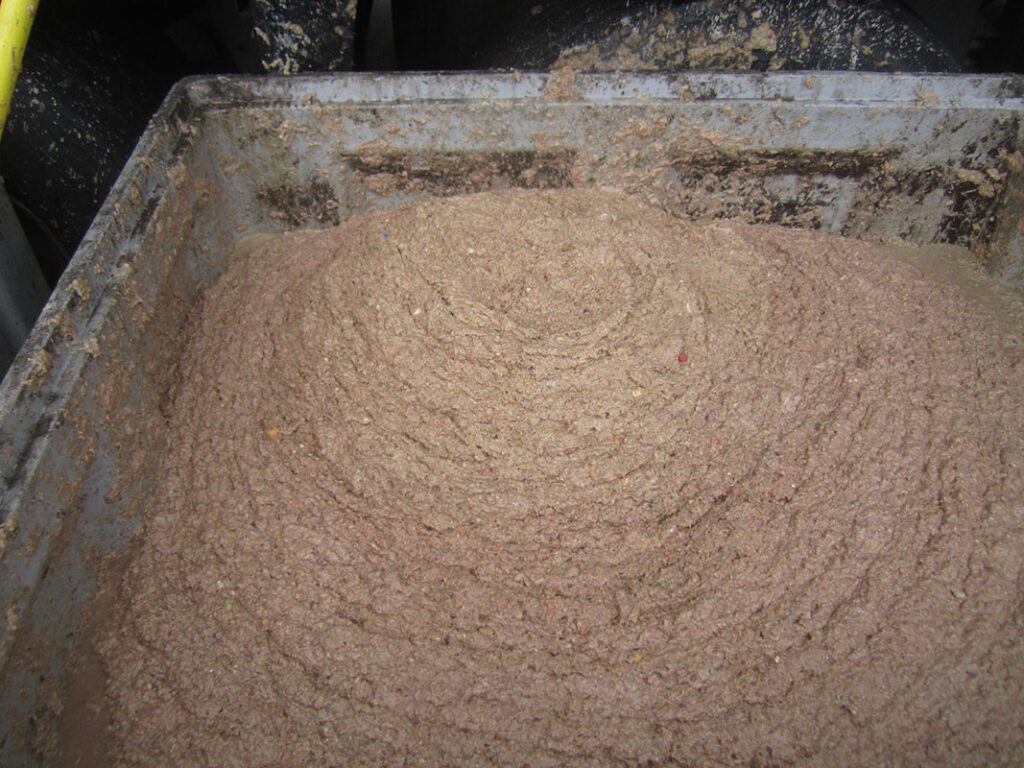
Post depacking, cyclone separators and filters can remove the last bit of glass, grit or residual plastic. Photo courtesy of Van Dyk Recycling Systems.
Cleaning and Maintenance
The average food waste operation requires some daily attention and cleaning. When dealing with expired food waste, this is not the most appealing part of operations. Smicon units have simplified that process. The entire machine can be opened, accessed and cleaned without any tool, crane or heavy lifting. Routine cleaning can take as little as 15 minutes, which encourages a crew to inspect and maintain the machine as recommended.
A separate feed chamber with heavy-duty replaceable impact plates and a hydraulic escape and access door on the feedside allows for initial impact protection, reduction of screen damage, and quick removal of troublesome materials without opening the remainder of the depacker. The initial hammer mill impact chamber opens up with safety keys and a hydraulic actuating door for easy access.
All moving parts, screening drum, hammer mill and drives can be accessed at waist height from a walk around the platform. The entire depacker can be opened up in less than 5 minutes (no tools needed) with full access to all sides. Removable quarter panels (no hoist required) enable full access to the entire interior screening chamber. Any of the individual screen sections can be removed or changed out at waist height with electric or pneumatic hand tools in less than 15 minutes.
This article was produced in partnership with Van Dyk Recycling Solutions and tailored for BioCycle’s audience.
Wilfred Poiesz is Vice-President, Western Region at Van Dyk Recycling Solutions, which serves the source separated organics market with the SMIMO 120 and 160 depacker models by Dutch manufacturer Smicon, along with a line of post-processing and refining equipment. Van Dyk has installed three depacking units on the West Coast and six more have been sold and scheduled for installation. For inquiries, contact Van Dyk.