Top Photo: Adobe Express
Paula Luu
The latest numbers from Waste Business Journal’s Waste Price and Volume Index point to a U.S. waste system in which both volume and price pressures are increasing, but not uniformly. The Northeast continues to face structural constraints and export more waste, while lower-cost regions absorb growing volumes. Meanwhile, rising disposal prices and capital investment are creating stronger incentives for recovery infrastructure.
The national weighted-average landfill tipping fee reached $72.14/ton in July, up 2.5% over 12 months, after nearly a year of relative stability in the $70 to $71 range. Daily landfill volume climbed to roughly 1.067 million tons, up 3.0% year over year. Combined with transfer stations and waste-to-energy facilities, total throughput reached approximately 1.667 million tons/day, up 3.3%.
The Regional Breakdown
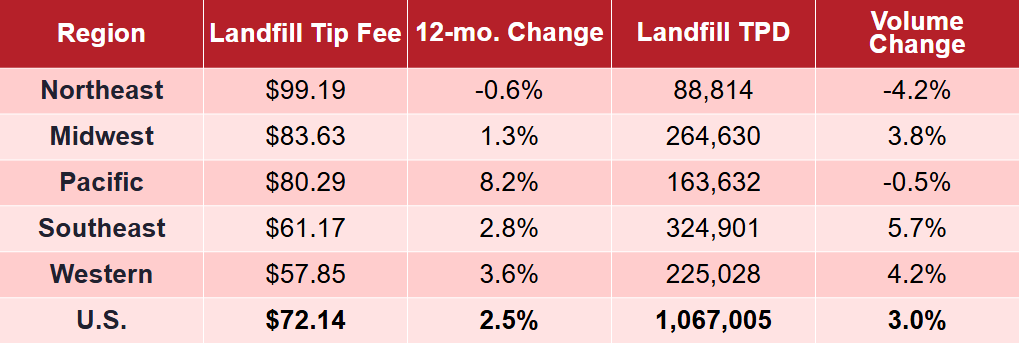
The Northeast remains the country’s most expensive disposal region at $99.19/ton, a function of high population density and a persistent shortage of landfill capacity. But Northeast landfill volume actually fell 4.2% over the past year, even as pricing there declined slightly. That combination points to waste being diverted elsewhere rather than landfilled locally.
The Midwest and Southeast are absorbing much of that outflow. Midwest tipping fees rose 1.3% to $83.63/ton, while the Southeast, already the nation’s largest landfill disposal region at nearly 325,000 tons/day, saw volume grow 5.7%, the fastest of any region. Florida, Georgia, North Carolina, Virginia, and Tennessee anchor that growth, with Florida alone handling more than 53,000 landfill tons/day.
Table 1. Regional Landfill Tipping Fees and Volume, July 2026
Click here to expand this image.
Source: Waste Business Journal’s Waste Price and Volume Index
The most dramatic price movement is in the Pacific region, where tipping fees jumped 8.2% over 12 months to $80.29/ton, even as volume there dipped slightly. California’s landfill price reached $80.68/ton, up 8.4%, while Washington posted the steepest state-level increase in the country at 16.6%. Oklahoma, Tennessee, Connecticut, Alaska, Florida, Colorado, Mississippi, and Utah all posted year-over-year increases above 6%.
Jim Thompson, Jr., president of Waste Business Journal, sees these regional dynamics as connected rather than coincidental. “Capacity constraints in the Northeast are leading to even more waste exported to the Midwest and Southeast,” he said. “Consequently, pricing is increasing there in response to increased demand.”
Transfer Stations Gain Ground
The data also shows transfer facilities pulling further ahead of landfills on price. Transfer stations averaged $83.24/ton nationally, roughly 15% above the landfill average, and transfer volume grew 4.7% year over year, outpacing the 3.0% growth in landfill volume. As interstate waste flows become more common, particularly out of capacity-constrained markets like the Northeast, transfer infrastructure appears to be capturing a growing share of the value chain.
Bringing it Back to Organics Recycling
Rising disposal costs typically strengthen the economic case for composting and anaerobic digestion (AD), and Thompson pointed to early signs of that dynamic already playing out. “Recovery volumes are ticking back up thanks to increased landfill pricing and especially to new investment in advanced materials recovery facilities,” he said.
That investment activity is not limited to materials recovery facilities (MRFs). Thompson noted that private equity remains active across the broader solid waste sector. “Private equity continues to make bets and actively seek deals to build on investments in regional players in an industry far from fully consolidated,” he said.
Regions with steep tipping fee increases, especially the Pacific and parts of the Southeast, present a strengthening cost case for composting and AD capacity. And with private equity still hunting for platforms in a solid waste sector that’s far from consolidated, there may be capital available for developers positioned to capture it.