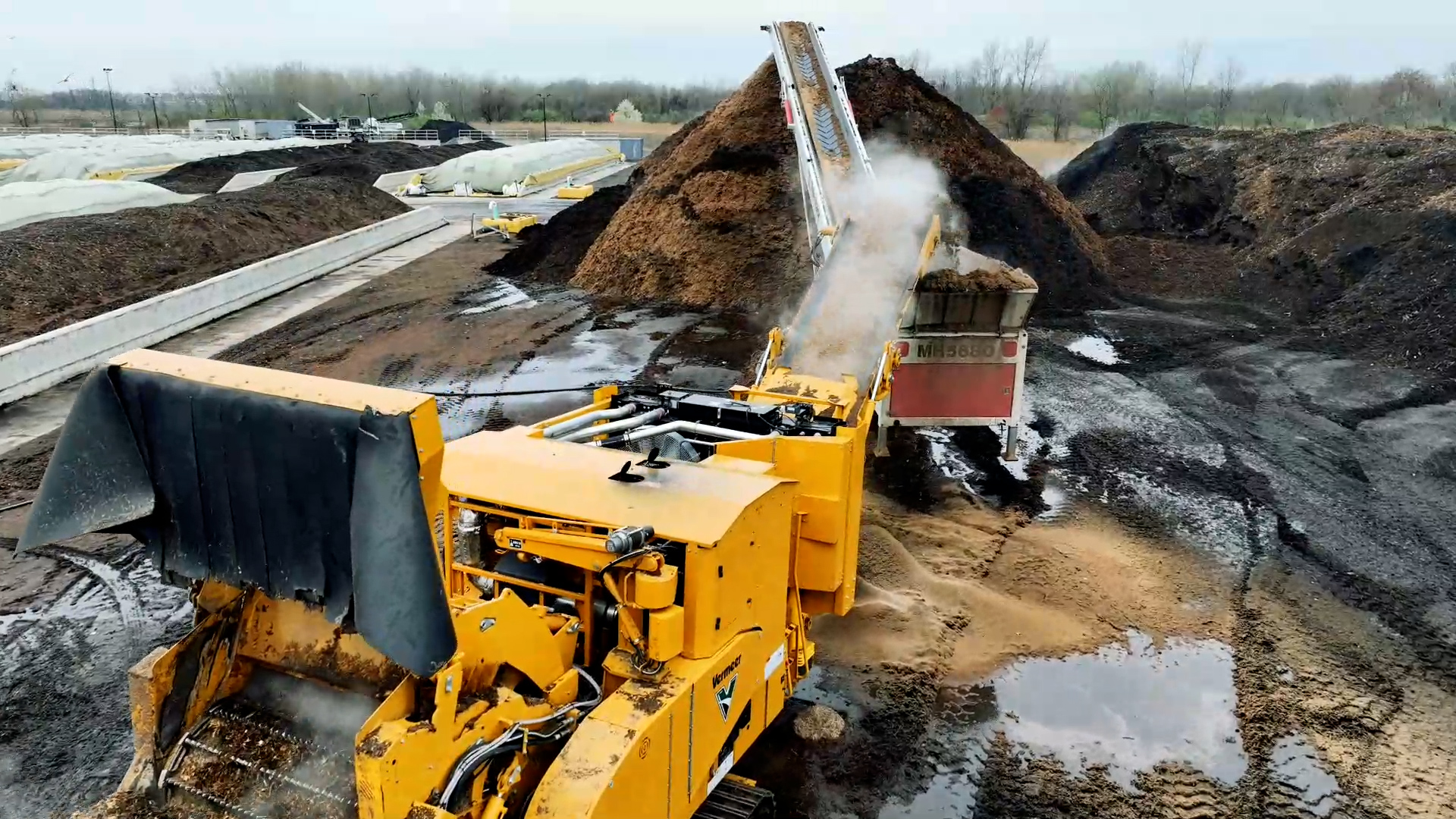
Staten Island’s composting facility is located at the closed Fresh Kills Landfill. Photo courtesy of DSNY.
Juliana Beecher
A new law is again expanding New York City’s organics collection, and raising the question of processing capacity. Uptake of the city’s mandates for residents and businesses to separate food scraps, yard waste and food-soiled paper have been slow, but Int. 31 is another step toward increased compliance. It builds upon Local Law 146 of 2013, the original law that mandated commercial organics be source separated.
Int. 31 went into effect on July 30, 2026. The new law modernizes Local Law 146 by expanding categories of businesses eligible to be designated and removing the requirement for businesses to publicly post their organics hauler and pickup schedule. As with Local Law 146, Int. 31 requires the Department of Sanitation (DSNY) to assess organics recycling capacity and pricing to ensure that organics recycling is available at a rate competitive with landfill disposal or incineration. If sufficient capacity is available and pricing is competitive, DSNY must then designate additional categories of commercial food waste generators to be subject to separation and diversion requirements, effective six months later.
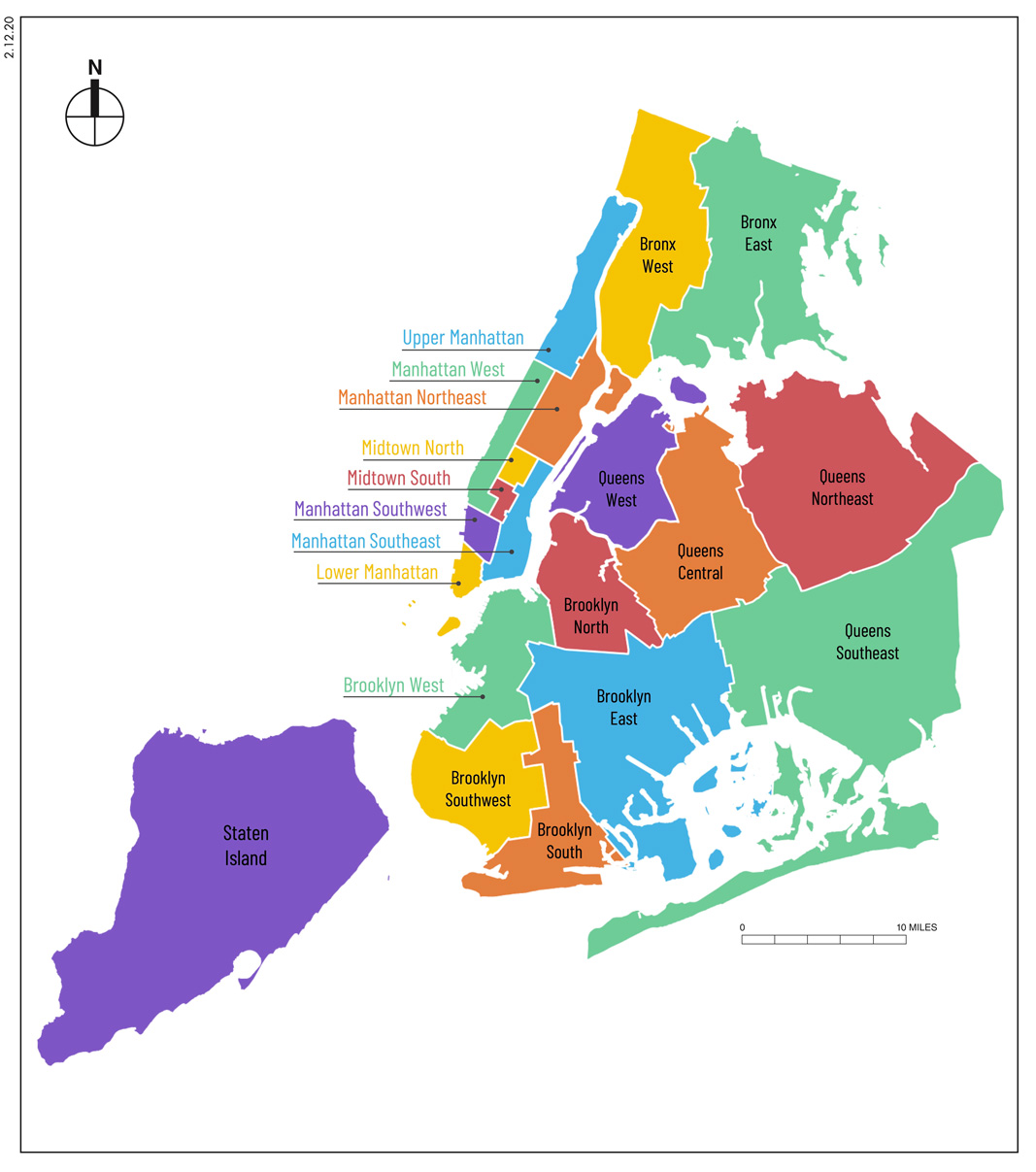
Int. 31 also aligns Local Law 146 diversion requirements with the phased-in rollout of NYC’s Commercial Waste Zone (CWZ) program (Figure 1). The CWZ program requires haulers to offer collection of organics and recyclables for less than general waste to incentivize businesses to source separate. Those incentives have seen limited uptake by businesses. Int. 31 aligns existing commercial diversion requirements with CWZ by requiring designated covered establishments to comply by the final day of the implementation period of the CWZ in which they are located (or within six months if their CWZ is already active). This alignment essentially establishes a timeline for designating additional categories of businesses for organics diversion compliance. (The CWZ program is currently in Phase 5 of 10 in its city-wide rollout. Dates are not yet set for the final two phases.) Int. 31 also requires CWZ awardee-carters to provide information about donation of edible food to all businesses they serve with organics recycling.
Figure 1. Map of Commercial Waste Zones
Assessing Existing and Future Capacity
According to NYC’s Draft 2026 Solid Waste Management Plan (26SWMP), as of 2025, NYC had capacity for processing 400,000 tons of organics per year at city-owned facilities and through existing contracts. Permitted composting sites within the city collectively managed approximately 85,000 tons of organics in 2025. Those include three sites owned by DSNY and operated by Denali: Staten Island Compost Facility, Rikers Island Compost Facility, and Soundview Park Compost Facility. Non-composting outlets include co-digestion at the Newtown Creek Wastewater Resource Recovery Facility, preprocessing at WM’s Varick Ave. CORe facility and American Recycling, and regional facilities outside the city’s limits. Figure 2 shows organics recovered for beneficial use in NYC in 2023. This is not comprehensive of all organics managed in NYC in 2023 (see Attachment E of the SWMP26 for more details).
Figure 2. Organic Materials Diverted for Beneficial Use, Calendar Year 2023 (tons)
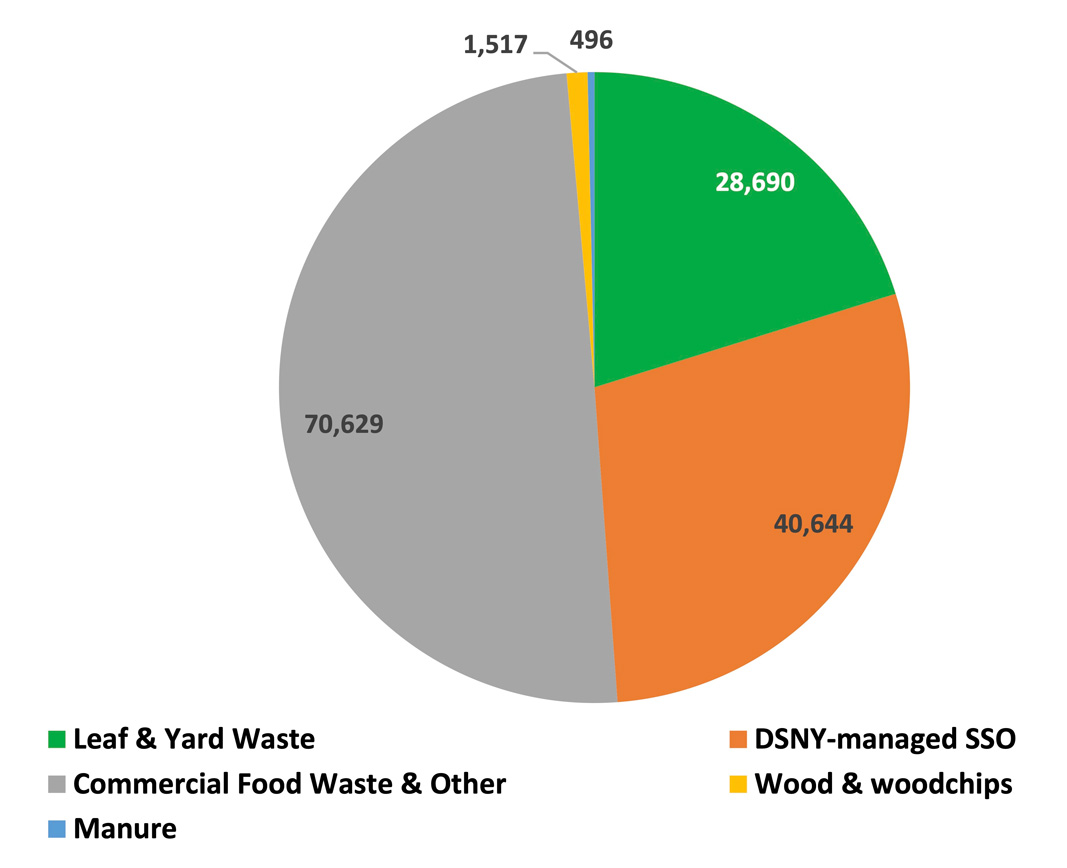
Source: NYC Draft 2026 Solid Waste Management Plan; data from private transfer stations and DSNY.
Notes: Leaf & Yard Waste are generated by residents and managed at DSNY-owned composting sites; DSNY-managed SSO include food waste and yard waste collected by DSNY; rescued food donations are not included.
NYC continues to explore options for organics processing capacity in the city, even as participation in residential organics collection has been low (it’s mandatory, and DSNY ramped up enforcement this year). Proponents of composting argue that future organics processing capacity expansion should be in composting, and that it’s possible to develop more sites across the city. They advocate for a decentralized network of compost sites, rather than more centralized processing — similar to the community composting sites that already exist and continue to get City Council support. The City’s Fiscal Year 27 budget includes $5.235 million for community composters to continue providing education, awareness, and engagement for residents, and $1.01 million for community composting sites at botanical gardens. Community composting has been a strong movement in NYC for decades, integral to getting residents to understand and adopt food scrap collection.
In 2024, Local Law 118 passed, requiring the creation of 5 additional composting sites in parks in each borough by 2028, but a lack of funding has stalled that process. A proposed bill, Int. 369, would require 180,000 tons/year of composting capacity in each borough. That capacity is not needed yet, but may be if residential organics collection increases. The Brooklyn Borough president’s office released a report in October, 2025, identifying new sites in Brooklyn that could be used for composting. Even though the residential capture rate is currently around 9%, DSNY estimates a capture rate of 30% in 2036, and a corresponding need for an additional 60,000 tons/year of processing capacity for the organic waste it manages from curbside collection, public schools and drop-off sites. NYC’s SWMP26 predicts that “with the implementation of proposed programs in the SWMP26, the tonnage of organics managed by DSNY is expected to exceed 440,000 tons in 2036, requiring additional capacity beyond what is currently contracted.”
The commercial sector looks a bit different. In 2023, private transfer stations accepted roughly 70,000 tons of commercial organics (presumed to be mostly food). This is approximately 10% of commercial organics generated (estimated at 0.7-0.9 million tons/year). Some commercial organics are hauled directly out of the city for processing. Those are not counted in the 10%. The diversion rate is expected to increase to 40% by 2036. According to the SWMP26, “In 2023, only around 30% of [private transfer stations’] capacity was used, leaving 70,000 annual tons of capacity at the Brooklyn Transfer, Hi-Tech Resource Recovery, and Regal Recycling transfer stations. Additionally, the Varick Avenue transfer station had around 900,000 tons of remaining permitted capacity for putrescible waste in 2023. Between these four transfer stations, there is sufficient capacity for the projected commercial organics tonnage.”
How the new local law, Int. 31, will affect the projected or actual growth of commercial organics diversion in NYC remains to be seen. At this moment, processing capacity for residential organics seems to be more pressing. But the commercial and industrial sectors are the largest current source of organic waste, and with additional categories of businesses becoming eligible for designation on a timeline established by the CWZ program, DSNY and City Councilors can see what lies ahead. The city will eventually need to process hundreds of thousands more tons of organics within the country’s densest urban environment. Whether and when that happens, however, will depend on increased capture rates and greater compliance from the city’s businesses and residents.