
Top Photo: Petco Park. Courtesy of San Diego Padres.
Paula Luu
In 2022, Meghan Ibach of Eco-Products met Risa Baron from Republic Services’ Otay composting facility in Chula Vista, California, at a conference. Republic had written compostable product acceptance into some city contracts, but wasn’t sure what would actually work in its composting system. Ibach offered to connect them to the Compost Research and Education Foundation’s Compostable Field Testing Program (CFTP) and help with the labor herself. A year later, Otay was field testing compostable packaging.
This is the origin story of what has become one of the most complete food waste and packaging diversion programs in Major League Baseball. Petco Park, home of the San Diego Padres, diverted 2,002.8 tons of waste from landfill in 2025 alone, including 856.1 tons of food and compostable serviceware routed to Republic Services’ composting facility. The team reported a 96% diversion rate during the 2024 season and was recognized with MLB’s Green Glove Award for its waste reduction and recycling efforts. In April 2026, Eco-Products was named an Official Zero Waste Partner of the Padres, formalizing a collaboration that had been years in the making.
Start at the End
The principle that made Petco Park’s zero waste program work is also the one most large venues skip. Eco-Products calls it the system solution. “Start from the end,” Ibach explained. “Work with the composter and say, ‘What works in your system? What can you accept?’ Then look into your MRF, and build the program backwards. That’s a missing link a lot of the time. That’s where a lot of composters feel burned.”
Rather than selecting compostable packaging based on price or availability and hoping it would be accepted downstream, the team started with Otay’s composting facility and worked forward. Between October 2023 and 2025, Eco-Products, Delaware North (Petco Park’s contracted food service vendor), and Republic Services ran multiple rounds of field testing at Otay using the CFTP protocol. The results were better than expected.

Meghan Ibach works with the Otay team to tie the mesh testing bags together. Each set of bags have long ropes to help locate them during testing.
Wendell Simonson, General Manager of Eco-Products, described what this approach actually flipped. “The typical frustration is when composters are being forced to take things they don’t want to take,” he noted. “What this did is flip that completely on its head. We started all the way at the very end with the composter doing the field testing, getting the buy-in, and then working backwards.”
The result was a vetted set of BPI-Certified and CMA-approved compostable products approved for use across Petco Park’s concessions, with the composter’s confidence built in from the start.
Contamination Is a System Problem, Not a Guest Problem
Once the right products were in place, the next challenge was keeping the stream clean after it left the concession stand. At a venue with millions of fans annually, that is not a signage problem. It is a system design and labor problem.
Petco Park invested in a dedicated sortation team running three shifts during the season. Delaware North switched a significant share of non-compostable products to compostable alternatives and introduced green cutlery to make identification easier, not just for guests but for sorters. Two-stream waste bins were installed throughout the park, capturing compostable and recyclable materials while eliminating landfill receptacles from the guest-facing experience.
Ibach was direct about what this investment signals. “Procurement really has to align as much as possible with either reusable or accepted by the composter,” she said. “With procurement aligned and the sorting team being dedicated like they are, it’s an investment for sure. But that’s what’s successful across the country with big stadiums and arenas. You really have to have some sort of touchpoint post-consumer if it’s going to succeed.”
The cost of labor argument is one that often stalls these programs before they start. Simonson pushed back on that framing. Sports and entertainment venues are already running janitorial teams through facilities after every event. The organic sort is an elevated mission layered onto work that is already happening. He pointed to the early days of the Green Sports Alliance, where the Seattle Mariners found that the organic sort “completely changed that whole staff’s orientation to their work. They were involved in a really important initiative, a cornerstone of what the organization was trying to do environmentally.” The labor often already exists.
Collaboration: The Common Thread
What the Petco Park story illustrates, more than any single tactic, is that composting programs at scale succeed or fail based on the quality of relationships across the value chain. In this case, that meant a compostable packaging supplier, a foodservice operator, a major league sports franchise, a composting facility, and a hauler all working from the same set of goals, with enough trust to share the messy early work.
Simonson put it simply: “The common thread is collaboration. The only reason these things ever work is if there’s actual collaboration throughout the value chain. That’s the hard part, especially because these are stakeholder groups that don’t often work with one another. If there’s any inventing happening, it’s the relationship building up and down that value chain.”
Ibach echoed this from the composter’s perspective. “When you really tap into the community level, where the composter is working with their big generators, and everybody is willing to put in the extra work to make sure everything is vetted and approved, and there are contamination mitigation controls, that’s where it really does shine,” she emphasized.
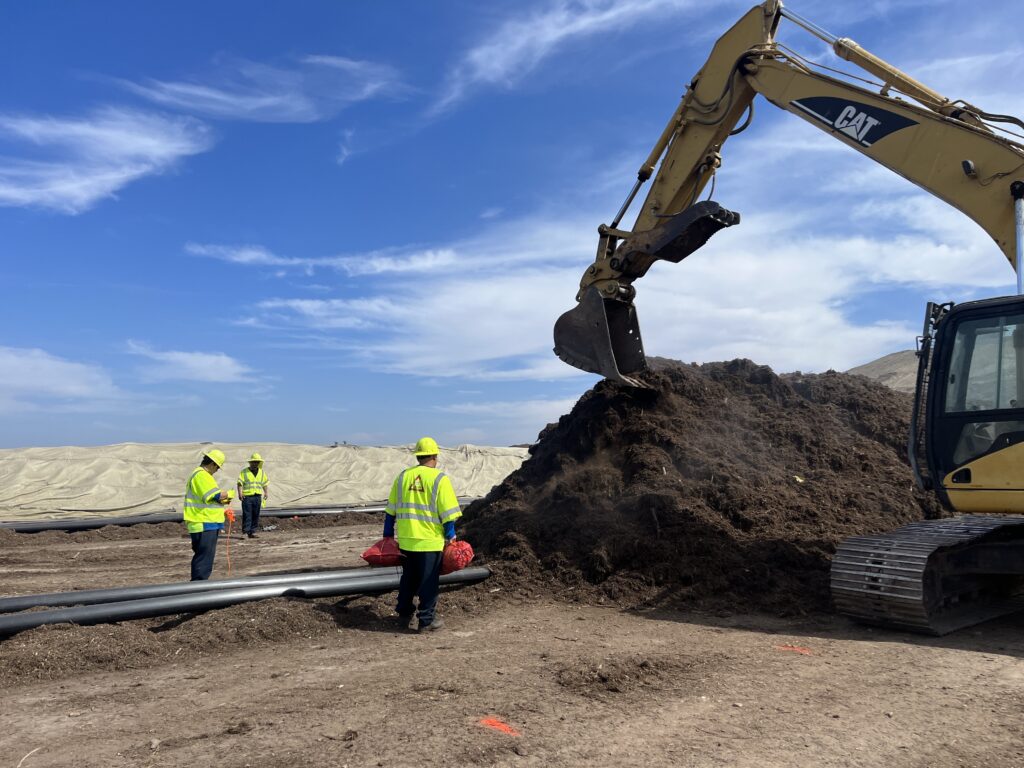
Otay Republic Services team preparing to lay compostable testing bags as a new composting row is built.
What Other Large Generators Can Take From This
Not every venue has the resources of a Major League Baseball franchise, but the lesson from Petco Park is more about process than budget.
What made this program work was not starting with packaging and hoping the rest would fall into place. The Padres and their partners started by understanding what the composting facility could actually process, then built the program backward from there. The steps were intentional:
- Products were tested in real operating conditions.
- Procurement decisions were shaped by end-of-life realities, not marketing claims.
- Collection systems were designed to reduce confusion for guests; and
- Post-consumer sorting was treated as an essential part of the infrastructure, not an afterthought.
Otay already sees broader applications. The facility is in conversations with the San Diego Convention Center and other large generators about creating curated collection routes that would bypass depackaging altogether, sending cleaner compostable streams directly to composting. According to Ibach, the Padres program has provided proof that the model can work.
While diversion rates and zero waste milestones often capture the headlines, they are ultimately outcomes of a much larger effort. At Petco Park, the more significant achievement may be the functioning closed-loop system already in place, built under real-world conditions with the composter, venue operator, procurement team, and waste managers working from the same playbook.