Juliana Beecher
In June 2026, the South Dakota Department of Agriculture and Natural Resources (DANR) released a Food Waste Composting Feasibility Study. The study, conducted by engineering firm Burns & McDonnell, evaluated feedstock availability, composting technologies, collection methods and storage containers, end markets, regulations, education, technical assistance, and investment needs to increase food waste composting across the state. The final report is both comprehensive and actionable, and provides a practical roadmap to implementation, complete with standard operating procedures and cost estimates for communities and facilities involved.
According to the report, about 236,000 tons of food waste are generated in South Dakota each year. The study assumed a 10% initial capture rate: roughly 23,600 tons annually. This food waste generation estimate is based on a 2023 solid waste characterization study from the City of Sioux Falls (the largest city in the state), which reported 13.6% of municipal solid waste to be food. That percentage was applied to permitted tons per year for landfills across the state, and checked by comparing it to the population in each landfill’s service area or “wasteshed.” The report provides estimates of food waste generated in 15 landfills’ wastesheds, with populations ranging from around 5,000 (Walworth County landfill) to over 300,000 (Sioux Falls landfill). The study is focused on residential food waste, though commercial and institutional generators are mentioned throughout. It recommends approaches to food waste composting be scaled appropriately to the size of the community served, such as the pathway for community-scale composting described in Figure 1.
Figure 1. Example Phased Pathway for Community Food Waste Composting
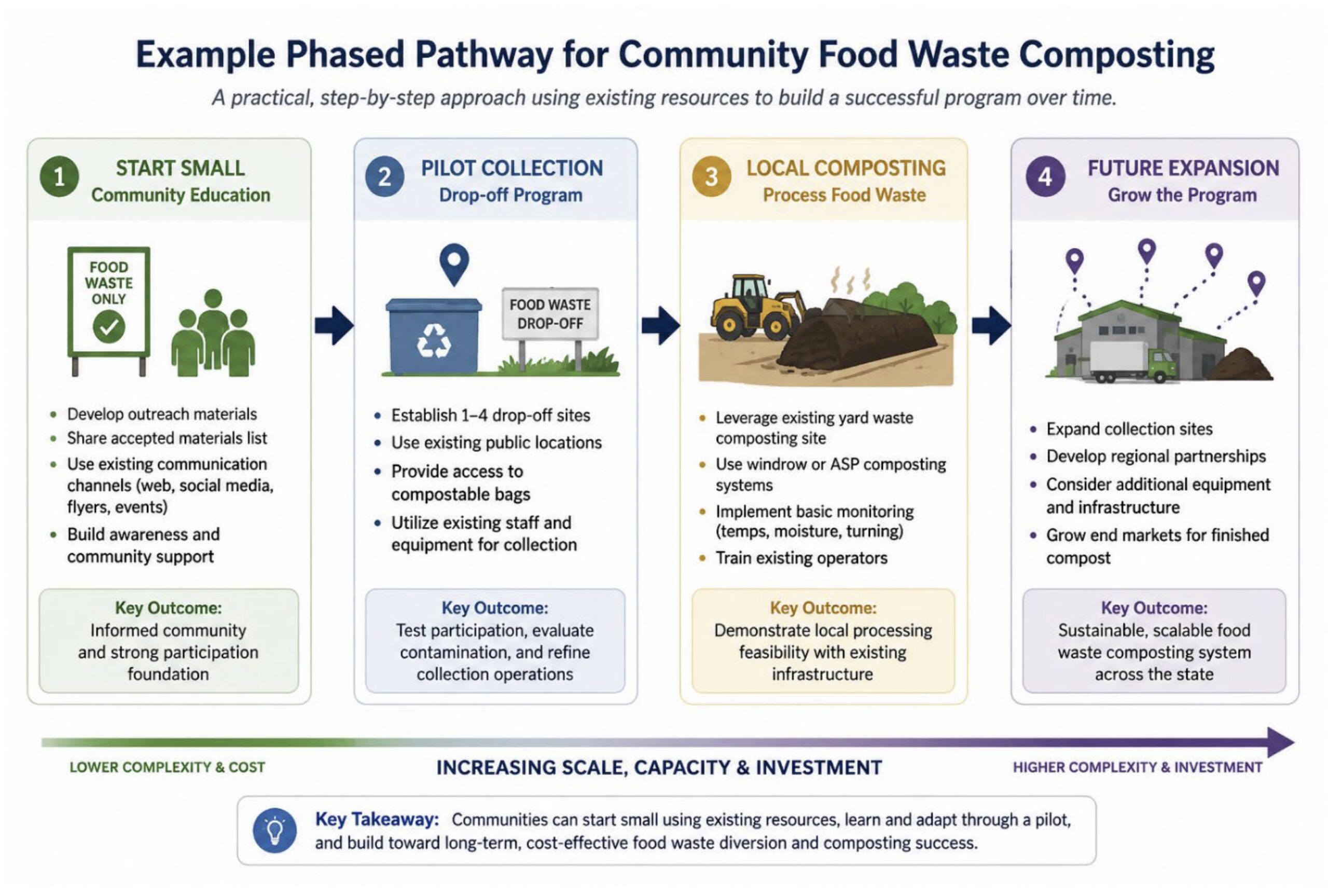
Source: South Dakota Food Waste Composting Feasibility Study. Click here to expand image.
In-vessel composting, aerated static piles (ASP), and windrows are compared as viable technologies for South Dakota, with case studies from composting operations in other Midwest and Plains states. Windrows are recommended in areas with land, plentiful carbon feedstock, and equipment; in-vessel is recommended for sites with space restrictions, smaller feedstock volumes, and odor control needs; ASP is recommended for mid-scale operations, larger operations with space or labor constraints, or for active composting in combination with windrows for curing. The report includes planning-level cost estimates for each of these technologies, plus individual pieces of equipment.
The study considers curbside collection and drop-off sites as potential collection models for residential food waste, pricing out scenarios for a small collection pilot, adding food waste to existing collection programs, and standing up new curbside collection or drop-off sites (Table 1 shows startup costs for drop-off). Options for collection and storage containers are described alongside educational materials for households to make any food waste collection program accessible and approachable. The report stresses the importance of outreach to reduce contamination from the very beginning.
Table 1. Estimated Startup Costs for Four Food Waste Drop-off Sites

Inconsistent quality of compost and access to free yard waste compost have been barriers to expanding end markets in South Dakota, according to the report. Yet opportunities exist with landscaping, tree nurseries, local government applications, residents, and community gardens. Recommendations are for more testing, specifications and demonstration projects to prove the quality of compost and impact of its use.
Regulatory Pathway
The regulatory pathway in South Dakota is not streamlined for food waste composting. The state has a general yard waste composting permit; for any feedstocks beyond yard waste, a facility needs an individual solid waste permit. As interest in food waste composting grows, DANR staff are considering what changes to the existing framework could create a simpler process, such as design and operational requirements.
Navigating the permitting process is one type of technical assistance (TA) identified in the study as necessary to help communities and facilities adopt food waste composting. Other areas where TA may be needed for food waste composting program startup — culled from a survey of staff at six solid waste facilities, case studies of established composting programs, and assessments of capital needs to manage food waste as a compost feedstock — include:
- Contamination prevention: Standardized, South Dakota-specific materials lists and generator guidance, backed by clear signage and bin labeling that make it easy for haulers and generators to sort correctly from day one.
- Staff education: Recurring trainings and refreshers — coordinated at the state level — for onboarding new staff and preparing seasonal operations, plus a standard operating procedures guidance for food waste collection and composting.
- DANR grants: State grants and loans to fund site improvements, equipment, and product testing, with funding structured for both pilot-ready sites and under-resourced communities so smaller projects aren’t shut out by application requirements created for larger facilities.
- Permitting navigation: Clear guidance on the permit pathway for adding food waste at existing compost sites, covering both pilot-scale and long-term expansion.
- Composting planning and site design: Right-sized site layouts and design guidance addressing traffic flow, stockpile placement, pad surfacing, and drainage — so new and expanding facilities aren’t having to design from scratch.
Use Existing Infrastructure
The strongest recommendation from the study is to start with existing infrastructure. South Dakota banned the landfill disposal of yard waste in 1995. As a result, most communities have permitted yard waste composting at landfills or on municipal land. Adding source separated food waste to those sites can be supported by existing staff and equipment, with accompanying TA for operators and education for community members. Compared to yard waste, food waste collection comes with a higher risk of contamination, requiring more engagement with community members to ensure streams stay clean.
This model was proven by a pilot conducted as part of the feasibility study. Through the survey of solid waste facilities, the City of Brookings’ Landfill was identified as a pilot location. Four drop-off sites were established, along with signage, home collection bin labels, and other materials utilizing the message, “Yep, you can compost that,” and clear Yep/Nope categories for food items. Within a week of the pilot’s launch in October, 2025, 140 residents had signed up to take part. Residents noted that convenient drop-off sites, free compostable liner bags, and clear signage made it easy to participate. City staff saw little contamination in the food waste stream, indicating that education and outreach to participants was effective.
The composting process during the pilot was less successful. Conditions were wintry and the pile was small and often froze. In the end, no final compost was produced that could be assessed for quality. In a future iteration, Brookings city staff would keep the approach the same, but time and scale the composting process appropriately to produce a quality compost, perhaps incorporating food scraps into existing yard waste windrows and planning around South Dakota’s coldest months.
Overall, the Brookings pilot proved that by starting with existing infrastructure, consistent, clear education for residents, accessible collection, and committed composting staff, it’s possible to launch a successful composting program that can then be scaled up. The feasibility study overall makes a strong case for adopting food waste composting in South Dakota with a deliberate, scaled approach, utilizing the well-established yard waste composting programs in the state. Best of all, the report offers actionable steps for communities of all sizes to get started, and may prove a useful resource beyond South Dakota’s borders.