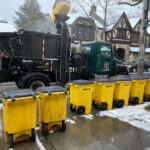
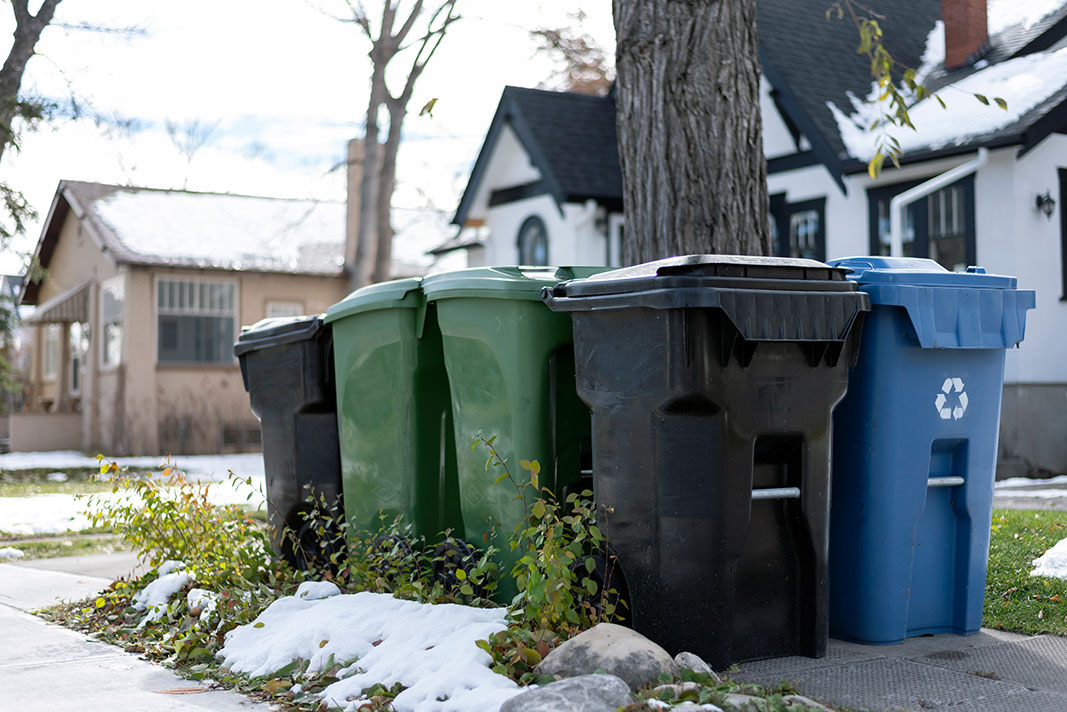
Top Photo: Residential organics cart set-out for curbside collection. Brett Holmes Photography/Getty Images.
Residents in Austin, Texas, pay about $28.50 a month at the low end for garbage, recycling and organics collection. In Raleigh, North Carolina, the comparable monthly charge for garbage and recycling without curbside organics is also $28.50.
The comparison comes from Comparative Cost Analysis for Residential Curbside Organics Collection Programs, , produced by Raftelis with support from the Natural Resources Defense Council (NRDC). The report profiles eight established programs, from Benson, Minnesota, with about 3,500 residents, to Austin, with 994,000. It also covers pilots in Nashville, Tennessee, and Durham, North Carolina. Raftelis worked from rate schedules, budgets and ordinances between winter and summer 2026 and interviewed program staff in most communities.
Mature residential organics programs typically account for 20% to 30% of a municipality’s total solid waste budget. Raftelis derived that range from cost-of-service budgets in Portland, Oregon, and Seattle, which break out food waste collection separately. The report cautions against reading the figure as the expected budget increase when organics is added, because several of the profiled communities paid for part of the new service by changing how garbage and recycling were collected when organics launched.
Raftelis compared four communities that offer curbside organics with peer cities of similar population, density, median household income and land area that collect only garbage and recycling. In two of the four pairs, the community with organics pays less.
Table 1. Monthly Fees: Communities with curbside organics vs. peer communities without them

Fees are representative single-family rates; Austin and Oakland rates vary by cart size. Source: NRDC/Raftelis (2026). Click to expand image.
Reworking The Rest Of The Route
When Edina, Minnesota, introduced weekly residential food waste collection, it shifted recycling from weekly to every-other-week service, using the savings to partially offset the cost of organics. About 14,000 eligible residential accounts now receive organics as a standard service and pay $5.63 per month. Hamilton, Massachusetts, paired weekly organics and recycling with every-other-week garbage collection.
Benson, Minnesota, combines garbage and source-separated organics collection in the same truck with the same crew. Residents place organics and garbage in separate clear bags inside a single city-provided cart, and the materials are separated after collection. The configuration avoids operating separate collection fleets for each stream for the small rural community of about 3,500.
Boise, Idaho, built food waste collection into an existing hauling relationship rather than procuring a standalone service. The city initially reimbursed the hauler about $2.50 per customer per month for food waste hauling and processing; that figure has since increased to $6.81. Boise also owns its composting facility, removing a third-party market-rate tipping fee from the arrangement. Roughly 31,000 tons of combined food and yard waste are collected annually.
The researchers distinguish between programs whose costs are simply tolerable to the municipality or participating households and those designed to reduce the underlying cost of service. An opt-in program, for example, may expose a municipality to very little direct cost because participating households pay the hauler themselves, but a small subscriber base can prevent the program from reaching economies of scale. Other communities have used participation requirements, billing structures, collection frequency and existing hauling contracts to lower the cost per household.
“The clearest difference was whether a community simply added organics to its existing system or used the launch to change how the whole system worked,” the Raftelis project team noted. “The strongest programs made the cost lower in the first place.”
For example, in Boise, organics collection is included in its base service, while households that opt out pay $34.73 per month compared with $27.30 for garbage, recycling and organics. The city reports 97% participation without a formal mandate. Edina similarly spreads costs across all eligible accounts through its $5.63 monthly organics fee. Across the communities studied, how residents were enrolled and billed made a big difference in cost, often determining how many households shared the fixed expenses of carts, trucks, routes and administration.
When municipalities ask what it costs to add organics, they may also be starting with the wrong assumption that organics represent an entirely new cost. Communities are already paying to collect, haul and dispose of food scraps and other wet organics in the garbage stream. The question is where those costs are directed. In markets where landfill tipping fees are rising, continuing to send organics to disposal is itself becoming more expensive.
There are relatively low-cost ways to start diverting organics. Communities with existing recycling drop-off infrastructure may be able to add organics collection with little capital, while private operators can sometimes assume the risk of building routes and managing collection. Municipal support may come through access to drop-off and processing sites, outreach, contracts or other public assets rather than direct ownership of the service. If less material ultimately moves to landfill, organics diversion becomes less about adding an expense than redirecting one the municipality already carries.
Participation Changes The Math
The economics of participation are particularly visible in Shorewood, Wisconsin, where roughly 350 of 4,800 eligible households subscribe directly to a private food waste hauler. Residents pay $12.25 to $14.75 per month depending on container size and payment structure, while the village contributes a $1.20 monthly subsidy per participating household. The subscriber count has remained relatively stable since the program launched in 2018. Those households are engaged, with a weekly set-out rate of about 70%, but participation of roughly 7% of all Shorewood households limits the customer base across which fixed costs can be spread.
Nashville is testing those economics at a somewhat larger scale. Its 750-household pilot costs approximately $6.75 per household per week, or about $27 per month, including bins and liners. The hauler has indicated that exceeding 1,000 subscribers could lower the rate to about $6 per week, while participant surveys suggest $10 to $15 per month is closer to what many households would voluntarily pay.
The report does not establish a specific participation threshold at which an opt-in program stops making financial sense. Its case studies instead illustrate the structural challenge: carts, vehicles, routes, administration and education still have to be funded, but fewer households are available to absorb those costs.
“Standard and mandatory programs avoid this ceiling by providing service to every eligible household and spreading costs across the full customer base,” the Raftelis project team said. The case studies, they added, suggest that opt-in service may be better suited to “a pilot or a low-risk entry point” than as a long-term cost model.
Prince George’s County, Maryland, followed that path, beginning with opt-in collection before expanding to standard service. Boise has taken a different route, making organics part of the standard residential package while charging customers more to opt out. Edina charges every eligible account whether or not a household regularly sets out its cart.
High enrollment still does not necessarily mean high volumes of organics are being captured. Austin provides organics service to more than 215,000 curbside customers as part of its standard residential package, but a 2020 waste characterization study found that roughly 25% of the material remaining in the garbage stream could be composted. Access, participation and capture are interconnected, but they but as this report illustrates, they are not the same measure.
Processing Can Change The Equation
Across the markets examined by NRDC, organics tipping fees ranged from effectively $0 per ton under some publicly controlled arrangements to more than $100 per ton in constrained private markets. Longer hauling distances add fuel and vehicle hours, while municipalities with only one realistic processor have less leverage on pricing.
Prince George’s County has a county-owned composting facility serving its curbside organics program for approximately 180,000 residential customers. County-contracted residential haulers currently pay no tipping fee at the facility; processing costs instead flow through the county’s solid waste enterprise fund and residential service charge. Residents pay approximately $29.75 per month for garbage, recycling and organics collection.
Boise likewise processes material at a publicly-owned facility. Austin has pursued a different strategy, awarding processing contracts to Organics by Gosh and Texas Disposal Systems and dividing material between the two. The arrangement provides multiple outlets and allows material to move to the closest appropriate facility. Austin is planning for processing needs to increase from roughly 44,700 tons to 60,000 tons annually as the program grows.
Processing availability affects more than the tipping fee. The facility accepting the material can determine whether food scraps and yard waste can be collected together, what contamination levels are acceptable and how far collection vehicles or transfer loads must travel.
“Municipalities should absolutely be considering and planning for processing alongside program design, rather than following program design,” the Raftelis project team told BioCycle.
The report identifies the cost impact of limited or distant processing capacity as an area requiring additional research, so it does not quantify how much processor access changes the economics across markets. The case studies nonetheless show the advantage available to communities that control their own processing or have more than one viable outlet.
When collection policy moves faster than processing infrastructure, material often has to travel farther until there is enough local volume to justify investment in new capacity. Composting infrastructure requires real capital — steel, concrete, equipment and permitting — and operators are unlikely to take that risk without confidence that sufficient tons will be available. Long-term feedstock and processing agreements can help provide that certainty for both lenders and operators deciding whether to invest. Until enough density develops, food waste may be hauled one or two hours to an available processor, something BioCycle is already seeing in parts of the South.
Municipalities can help close that gap with assets that are not necessarily direct cash contributions. They can make land available, expedite permitting, aggregate dependable volumes or enter into longer-term processing agreements that reduce risk for operators. Those partnerships can support investment in closer processing capacity, reduce transportation distances and create more stable tipping arrangements for both municipalities and processors, a dynamic BioCycle recently explored in its reporting on financing New Jersey’s food waste recycling infrastructure.