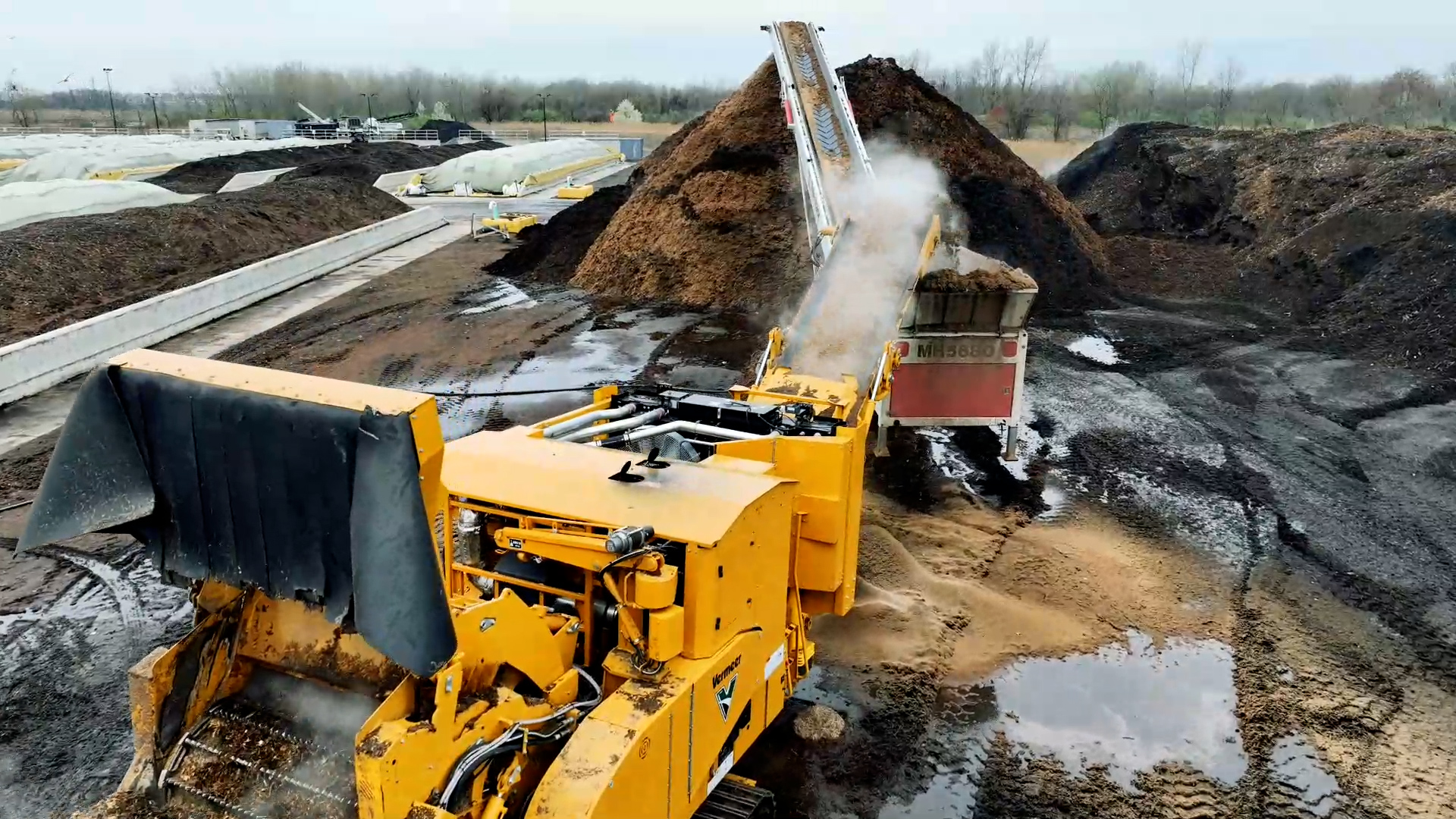
Top Photo: Staten Island’s composting facility is located at the closed Fresh Kills Landfill. Photo courtesy of DSNY.
The New York City Department of Sanitation (DSNY) has issued a Request for Information (RFI) to support a major upgrade to the Staten Island Compost Facility (SICF), with a focus on improving the pre-processing of commingled organics.
The RFI is seeking input from equipment manufacturers and technology providers on systems capable of removing contamination from source-separated organics (SSO) prior to composting. Responses will inform the design of a new pre-processing building and future procurement as DSNY expands its organics program across all five boroughs.
Located within the Fresh Kills closed landfill complex, the 33-acre Staten Island Compost Facility has evolved from a yard trimmings site only into a mixed organics processing facility, now handling both yard trimmings and food waste. A portion of the yard trimmings are composted separately in windrows. Following the citywide expansion of organics collection in 2024, the facility has seen a significant increase in incoming material, along with higher contamination levels.
Current operations rely on a combination of manual and mechanical pre-processing, followed by composting in a covered aerated static pile system and curing in open windrows. The proposed upgrades are intended to modernize that front-end system and improve feedstock quality before material enters composting.
Central to the project is the construction of a new 24,000-square-foot enclosed pre-processing building designed to handle commingled organics more efficiently. DSNY is targeting a system capable of processing approximately 35 tons per hour while achieving high organics recovery rates, with a goal of capturing more than 75% of incoming organic material.
The RFI outlines a multi-step processing approach that may include shredding for bag opening and size reduction, magnetic separation for metals, screening to remove oversized contaminants, and depackaging systems to separate organic material from packaging. Conveyors and hoppers would integrate these steps into a continuous processing line, producing a uniform feedstock for composting while diverting residuals to disposal.
The enclosed design is also intended to address operational challenges, including odor control, vector management, and stormwater exposure, while allowing for more consistent processing under varying seasonal conditions. The facility is expected to operate up to 16 hours per day, six days per week as volumes increase.
The RFI is informational and will be used to evaluate available technologies and system configurations. DSNY is also accepting alternative approaches that meet some or all of the project’s performance objectives.
Responses are due by May 22, 2026. The full RFI can be accessed through the City’s procurement portal.