

Top Photo: Adobe Express.
A new report from ReFED and YouGov suggests that rising grocery prices are reshaping how Americans buy, prepare, and manage food, with an unexpected side effect. Many households report wasting less. Drawing on a nationally representative survey, the research indicates that affordability, rather than environmental concern alone, may be one of the strongest motivators for reducing household food waste. For the composting and food recovery sector, the findings point to a timely opportunity to reframe food waste prevention around saving money while continuing to deliver environmental benefits.
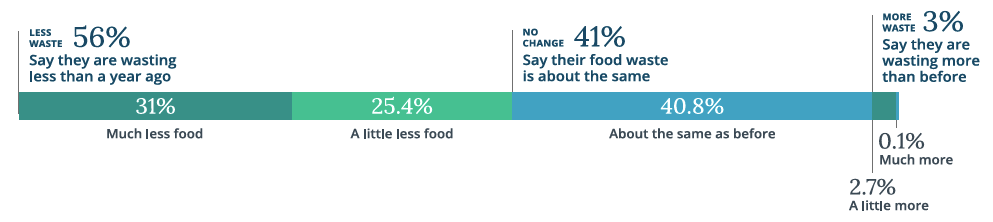
The survey, conducted in January 2026 with a nationally representative sample of 1,000 households, found that 56% of respondents reported wasting less food than the year prior, with 31% saying they were wasting much less. That self-reported improvement tracks against broader ReFED estimates showing American households generated 950,000 fewer tons of surplus food in 2024, a nearly 4% decrease.
Figure 1. Change in self-reported food waste due to grocery price shifts in the past twelve months (%)
Click image to enlarge. Source: ReFED 2026
A full 58% of survey respondents said their grocery spending had increased over the past year, and among those, 93% attributed the increase directly to food prices. The median household reported spending about $50 more per week, adding up to roughly $2,600 annually on top of a baseline weekly grocery bill of $150. For households earning under $40,000 a year, that increase represents more than 10% of total annual income. For households earning $150,000 or more, it represents about 1.5%. The same dollar amount hits the lowest-income households nearly seven times harder; approximately 32 million American homes fall into that lower-income category.
As grocery bills have grown, many households have adjusted both their shopping habits and the way they use food at home. Among households reporting increased grocery spending, the most common adaptations were looking for sales and deals (84%), cutting back on non-essentials (75%), switching to less premium brands (63%), and buying larger or bulk packages (61%). Food management behaviors followed a similar pattern, with households reporting more frequent meal planning, more deliberate use of leftovers, more freezing of perishables, and more attention to what was already in the refrigerator before buying more.
ReFED authors of the report, Marigold Walkins and Ana Gomez Lemmen Meyer, found that no single behavior was a reliable predictor of waste reduction on its own. What mattered was stacking behaviors together. Each additional behavioral change corresponded to roughly an 8% increase in the probability of reporting less waste among households spending more on groceries, and households that had adopted three or more changes were at least 24% more likely to report wasting less food. Meal planning and using leftovers emerged as the two highest-impact anchors, particularly for lower-income households, where meal planning alone corresponded to a 53% increase in the probability of reporting reduced waste.
The income disparity finding is where the report’s implications get complicated. Lower-income households face the greatest financial pressure and therefore have the strongest economic incentive to reduce food waste, but the survey found they reported fewer behavioral changes overall. The authors are direct about what that means: without support that addresses structural barriers, food waste interventions targeted at lower-income households will hit a ceiling regardless of how well they are designed. Time constraints, limited storage infrastructure, lack of access to bulk purchasing, and the cognitive load of financial stress all work against the kinds of deliberate, multi-step behaviors that drive waste reduction. Messaging alone will not close the gap.
The report points toward a few concrete directions. Framing waste reduction as a savings opportunity rather than an environmental imperative is more likely to resonate with households under financial pressure. Practical tools such as meal planners, storage guidance, and recipes that use common leftover ingredients have a measurable impact when paired with behavioral nudges. On the policy side, the authors call for passage of the Food Date Labeling Act, which would standardize date labels to “Best If Used By” and “Use By” across the country, a change estimated to generate $1.3 billion in annual consumer savings by reducing confusion-driven disposal.
The report identifies a more durable opportunity than simply responding to high grocery prices. Rather than relying on economic pressure to change behavior, ReFED argues that food waste reduction efforts should emphasize affordability as a lasting consumer benefit while pairing that message with practical tools such as meal planning, leftover recipes, and food storage guidance. The research also suggests that helping households adopt several complementary habits, rather than promoting a single action, is more likely to reduce waste. For lower-income households, the report recommends going beyond messaging by addressing practical barriers through food assistance programs and other targeted support.