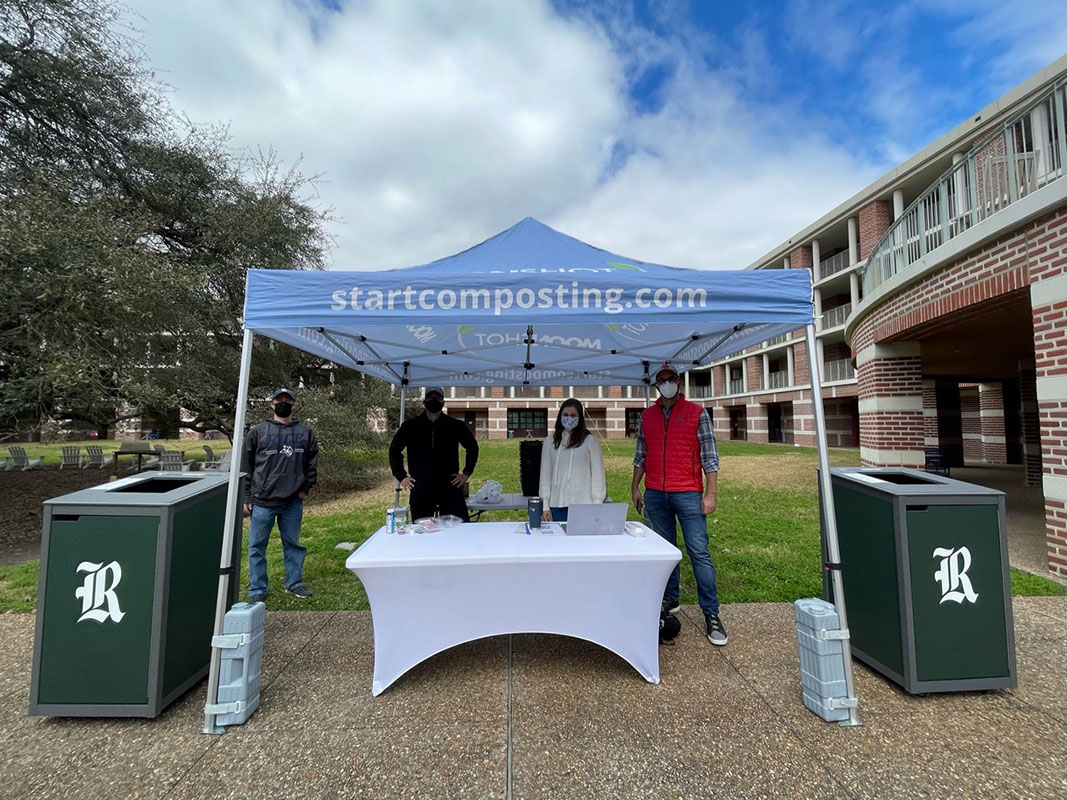
Top Photo: Student volunteers spread the word about composting on campus. Photo courtesy of Rice University.
Paula Luu
Rice University in Houston has composted more than 2 million pounds of food waste since launching its program in November 2020, a milestone reached through a partnership with Houston-based Moonshot Compost. The university’s Office of Sustainability and the Housing, Dining & Hospitality department report that the program now spans 15 campus locations and has avoided an estimated 2.02 million pounds of carbon dioxide emissions, a figure the university compares to planting more than 100,000 trees. The West Servery leads all locations with nearly 370,000 pounds composted.
“Collaboration has been central to the success and growth of Rice’s composting program with Moonshot,” said Kristianna Bowles, Associate Director for Sustainability in Rice’s Office of Sustainability, noting that the program’s effectiveness depends on support from Housing, Dining & Hospitality, the sustainability office, students, faculty and staff alike.
The program’s design reflects a deliberate, staged rollout. Rice and Moonshot started by collecting food waste in back-of-house prep areas, a more controlled environment that let the two partners “identify operational challenges, clarify what could and could not be composted, and establish consistent collection procedures” before expanding to front-of-house, diner-facing bins. As the program grew, right-sizing collection infrastructure became a central challenge, since each servery differs in size, customer volume and operating schedule. Moonshot developed a concise onboarding guide to keep training consistent despite regular dining staff turnover.
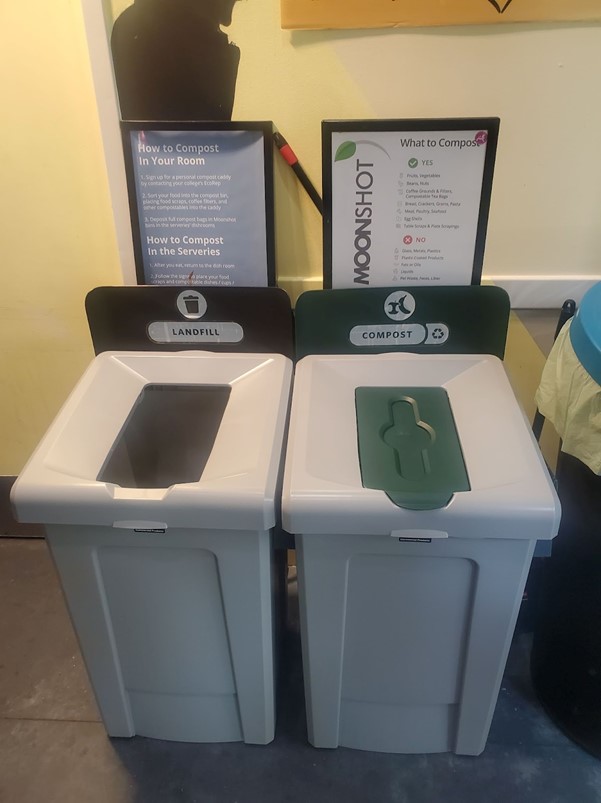
Front-of-house bins are set up to collect food waste. Photo courtesy of Rice University.
Chris Wood, Co-Founder of Moonshot Compost, said the company has learned that “training and re-training solves everything, especially when dealing with constant student and staff turnover.” He added that a durable institutional relationship depends on “providing real-time data and working with the customer to dynamically adjust the program’s size and cost based on usage over time.”
Contamination control has relied heavily on where and how front-of-house composting is offered. Rice deliberately excludes public-facing dining facilities from front-of-house composting, limiting it to student-facing areas where EcoReps, student employees within the sustainability office, can staff compost stations during peak dining periods. “In public-facing campus dining facilities,” this level of training and monitoring is not possible, specifically to avoid potential contamination,” explained Bowles. That targeted approach has kept contamination low without requiring campus-wide monitoring.
Moonshot reinforces the separation operationally, too. Wood said the company keeps front- and back-of-house data separate “by using different color containers for each program,” which helps “isolate any contamination from the public-facing containers, so it doesn’t spread to back-of-house collections.” The color-coded system also gives Rice cleaner visibility into what each side of the program costs to run.
That granular data has already shaped physical changes to how Rice serves food. Wood pointed to Moonshot’s per-drum tracking as the evidence base behind Rice’s decision to build “an intermediate area for hot food service lines,” where prepared food is held at temperature and moved out in smaller batches. The change, he said, “has significantly reduced waste because they can repurpose food at the midservice point.”
Improved Signage
Signage has evolved alongside the collection infrastructure. EcoReps and sustainability interns redesigned original signs, which Bowles said had “become less effective over time due to its familiarity,” later incorporating college-specific colors, imagery and traditions, along with QR codes linking to Moonshot’s real-time diversion dashboards. New signs carry English and Spanish translations and are printed double-sided so messaging can rotate through the year. In the dorms, Wood said, students can complete a short video and quiz to receive a reusable Umimax container and compostable bags from Biobag, giving highly engaged students a way to bring food waste from their rooms to front-of-house bins “without the complexity of tracking equipment blindly distributed to all.”
Layered onto this collection system is Metafoodx, an AI tool implemented by Housing, Dining & Hospitality and piloted at the Sid Richardson College commons. Students scan their plates after eating and before scraping scraps into the compost bin, while AI separately analyzes leftover trays of unused prepared food from the serving line to estimate the quantity. Together, the two data streams capture both diner-side waste and kitchen-side overproduction, closing a gap that end-of-service tracking alone tends to miss, since food held in warmers and chillers never reaches a plate at all. Rice is now evaluating whether to expand MetaFoodx to serveries across campus this fall.
Rice frames the 2 million-pound milestone as the product of sustained collaboration across students, dining operations and outside partners, pointing to the university’s Living Lab Program as the framework that enabled a student-driven composting effort mature into one layered with AI-based forecasting tools. Richard Johnson, senior executive director for sustainability, has said the milestone reflects more than landfill diversion, describing the campus as a living laboratory where everyday actions translate into measurable environmental impact. Bowles added that student ownership “has helped make composting visible, accessible and part of daily campus life.”
Together, the operational discipline behind collection logistics, contamination control and staff training, paired with new AI-driven measurement tools, illustrates how a campus composting program moves from a diversion pilot to an institutional system built on data, one that Rice and Moonshot say is still evolving as the university tests how far AI-assisted tracking can extend across its dining operations.